 HTTP vs HTTPS Explained Simply for Beginners
 If you have ever seen a website start with http:// or https:// and wondered what really changes, this page will help you build a clear mental model that sticks.
HTTP sends website data like an open postcard.
HTTPS sends website data like a sealed, tamper-resistant envelope.
So the main difference is simple:
- HTTP does not protect the message in transit
- HTTPS protects the message using encryption and identity checks
If you only remember one thing, remember this: HTTPS is the safer version of HTTP.
Quick Comparison Table
| Feature | HTTP | HTTPS |
|---|---|---|
| Full form | HyperText Transfer Protocol | HyperText Transfer Protocol Secure |
| Security | Not encrypted | Encrypted |
| Privacy | Others may read data in transit | Data is protected in transit |
| Trust | No built-in identity verification | Verifies the site with a certificate |
| URL prefix | http:// | https:// |
| Browser padlock | Usually no | Usually yes |
| Best use | Rarely appropriate for public websites today | Standard choice for modern websites |
Story Hook
Imagine two ways of sending an important message across a city.
In the first case, your note is written on a postcard. Anyone handling it on the way can read it.
In the second case, the note is sealed inside a locked envelope. People can carry it, but they cannot easily open it or secretly change it.
Both messages travel to the same destination.
But they do not travel with the same level of protection.
That is the easiest way to start understanding HTTP vs HTTPS.
Main Analogy
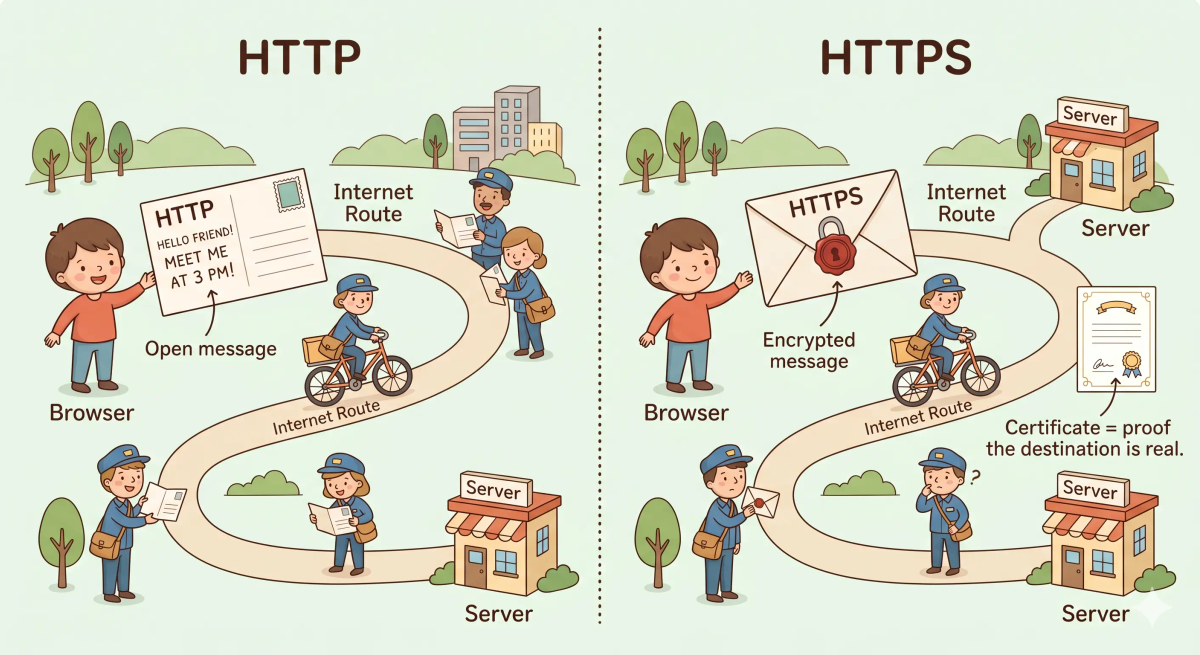
Think of HTTP and HTTPS like sending a message through the mail
- Your message = the website data being sent
- The postal route = the internet path between browser and server
- Open postcard = HTTP
- Sealed locked envelope = HTTPS
- Official stamp proving the sender is real = the website certificate
So the easiest way to understand this comparison is:
- HTTP = message sent openly
- HTTPS = message sent privately and with proof of identity
What Problem Does Each One Solve?
If you just want two computers to exchange web information, HTTP is enough to define the basic rules for that conversation.
But if the message travels openly, someone in the middle may be able to read it, copy it, or change it.
That is where HTTPS becomes important.
In the analogy world:
- With an open postcard, the message is exposed during the trip.
- With a sealed envelope, the message is protected while traveling.
- With an official verified seal, you also gain confidence that the destination is the real one.
In the real world, that means:
- HTTP helps browsers and servers communicate.
- HTTPS helps them communicate securely.
So the real difference is not that HTTPS is a totally different web system.
It is that HTTPS is HTTP with security added on top.
How the Difference Works in the Story
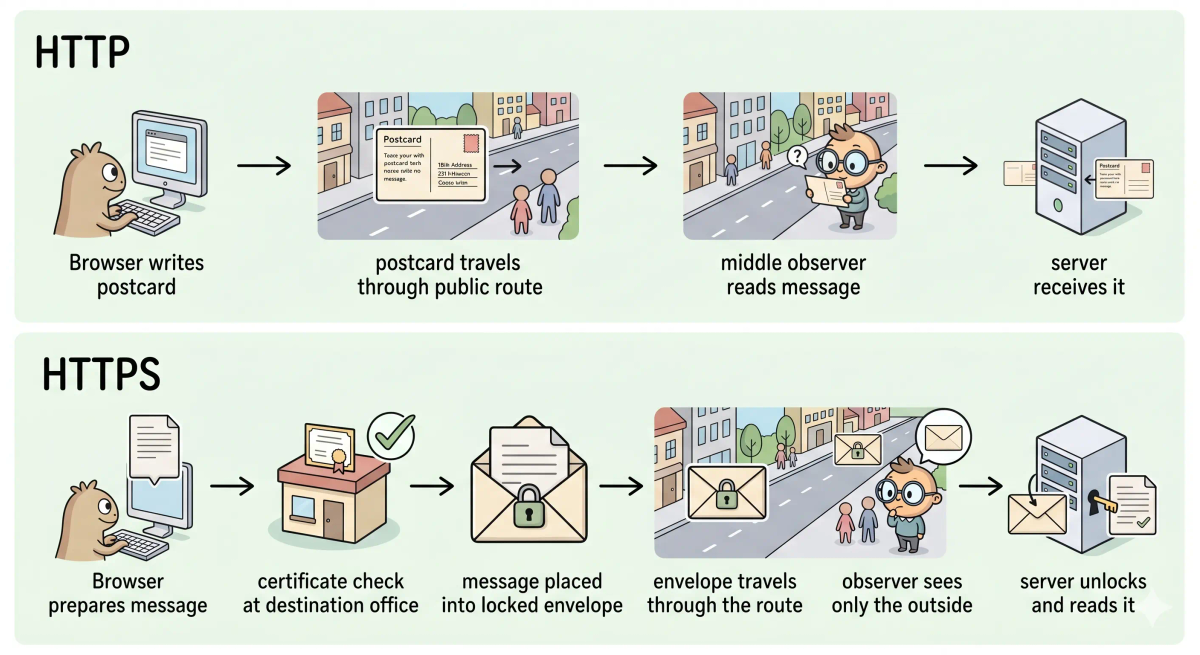
HTTP in the story
- You write a message on a postcard.
- The postcard travels through many hands.
- Anyone handling it can read what it says.
- Someone could even swap or alter the note.
- The receiver gets the message, but the trip was not private.
HTTPS in the story
- You write the same message.
- You place it in a sealed envelope.
- The envelope is locked so outsiders cannot easily read it.
- The envelope also carries an official mark proving the receiver is genuine.
- The receiver opens it safely at the end.
How the Difference Works in the Real World
HTTP in the real world
- Your browser connects to a website server.
- The browser and server exchange data using HTTP rules.
- That data is not encrypted in transit.
- Anyone with the right access in the middle may inspect or modify what is being sent.
HTTPS in the real world
- Your browser connects to the website server.
- Before normal web data is exchanged, a secure setup happens.
- The website presents a certificate to prove its identity.
- The browser and server establish encryption.
- Regular HTTP communication now happens inside that protected connection.
👉 That means HTTPS keeps the familiar web conversation, but wraps it in security.
Real-World Example
Example: Logging into a website
When you log into a website, your browser sends information such as your username and password to the server.
If that happened over HTTP, the data would travel without proper encryption.
If it happens over HTTPS, the data travels inside an encrypted connection, which makes it far harder for someone in the middle to read it.
That is why login pages, payment pages, banking sites, and almost all modern websites use HTTPS.
The Difference Mapped Clearly
HTTP
- Focuses on the rules for transferring web content
- Tells browser and server how to request and send pages
- Does not by itself protect the contents during the trip
HTTPS
- Uses the same basic web request-response model
- Adds encryption and certificate-based identity verification
- Protects the contents while they move across the network
A good mental shortcut is:
HTTP = web communication
HTTPS = secure web communication
What HTTP and HTTPS Are Not
HTTP vs HTTPS is not the same as…
- HTTP vs HTML — HTML is the content format of a webpage; HTTP/HTTPS are the rules used to transfer it.
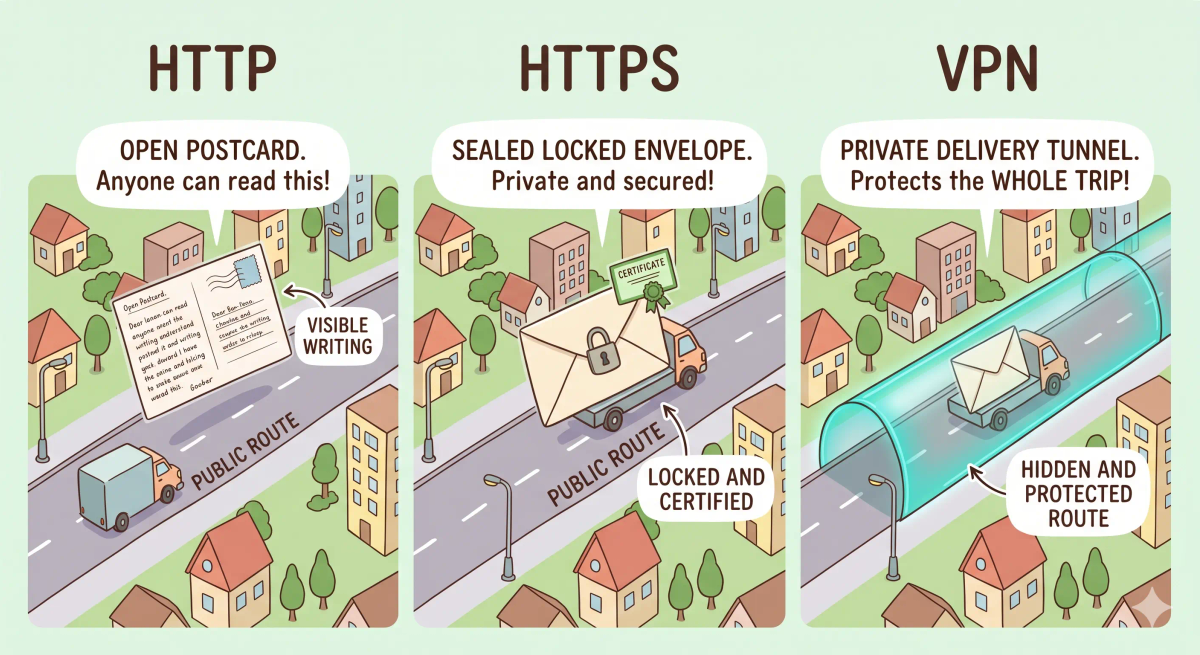
- HTTPS vs VPN — HTTPS protects a connection to a website; a VPN protects traffic between your device and the VPN server.
- HTTPS vs firewall — A firewall filters traffic; HTTPS encrypts traffic.
- HTTPS vs password — A password proves who you are; HTTPS protects data while it travels.
So while these ideas are related, the unique job in this comparison is understanding whether web data is traveling openly or securely.
Why HTTPS Matters
- It protects sensitive information in transit.
- It reduces the chance of data being read or altered on the way.
- It helps users trust that they reached the real website.
- It is the expected standard for modern websites and browsers.
This matters because HTTPS helps make the web safer to use every day.
Remember it like this: the next time you see the padlock in your browser, think of a message that is not traveling as an open postcard anymore.
A Slightly Deeper Version
A slightly deeper way to think about this comparison is that HTTP is the application-layer protocol for web communication, while HTTPS is HTTP carried over a secure encrypted connection, usually built with TLS.
That secure layer does two big things:
- Encrypts the data so outsiders cannot easily read it.
- Authenticates the website using a certificate so your browser can verify who it is talking to.
So technically, HTTPS is not a replacement for HTTP’s job.
It is HTTP with protection added around it.
Common Questions
Is HTTPS just HTTP with security added?
Yes. That is the simplest correct way to think about it.
Can HTTP still work?
Yes, it can still function technically. But for most public websites today, it is not the right choice because it lacks transport security.
Does HTTPS mean a website is completely safe?
No. HTTPS protects data in transit and helps verify identity, but it does not guarantee that the whole website is trustworthy or bug-free.
Why do browsers warn me about HTTP sites?
Because information sent over HTTP may be exposed or changed during transit, especially on untrusted networks.
Does HTTPS make websites slower?
In modern practice, the security overhead is usually small and worth it.
In Short
- HTTP is like sending a message as an open postcard.
- HTTPS is like sending it in a sealed, verified envelope.
- Both help browsers talk to servers.
- The big difference is that HTTPS protects the data during the trip.
- That is why modern websites should use HTTPS.