 What Is Encryption? Explained Simply for Beginners
 Imagine you want to send a very private letter to your friend.
If you write the message on a plain postcard, anyone who sees it on the way can read it.
So instead, you place the letter inside a special locked box.
Only someone with the correct key can open that box and read the message inside.
To everyone else, the message is hidden.
That is the easiest way to start understanding encryption.
Encryption is a way of scrambling information so that only the right person or system can read it.
Main Analogy
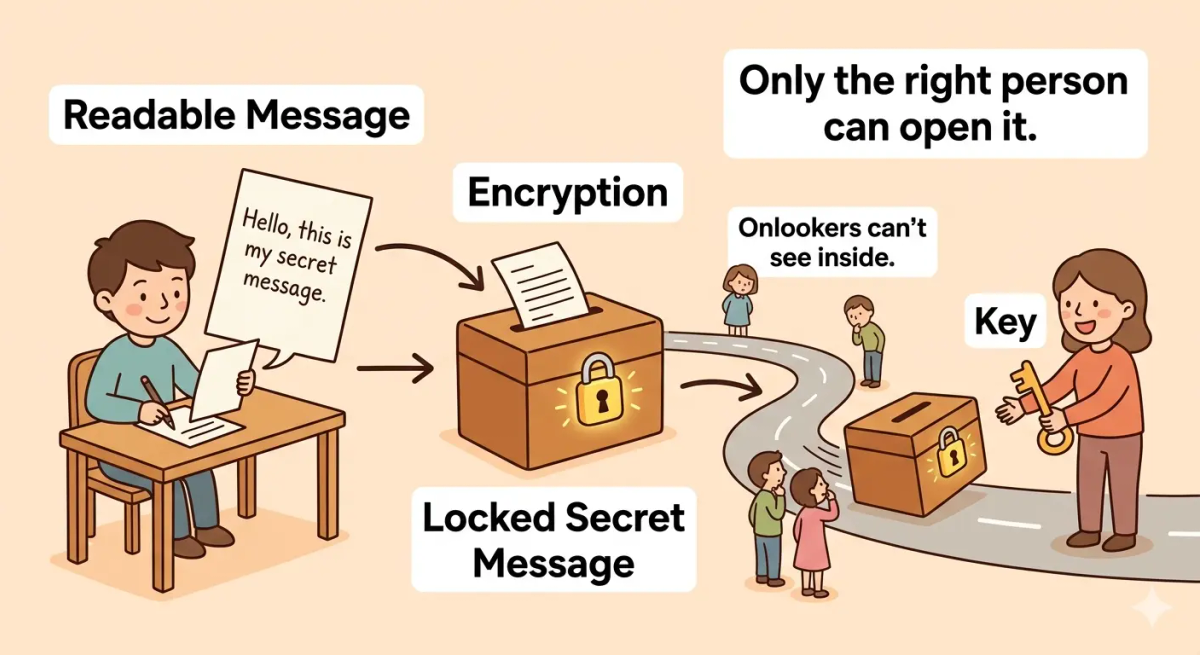
Think of encryption like putting a secret letter inside a locked box
- Plain message = the normal readable letter
- Encryption = locking the letter inside the special box
- Encrypted data = the locked box that outsiders cannot easily open
- Key = the special key used to lock and unlock it
- Decryption = opening the locked box so the message becomes readable again
So the easiest way to understand encryption is to think of it as turning a readable message into a locked secret version that only the right key can open.
What Problem Does It Solve?
If secret letters always traveled in the open, anyone along the route could peek at them.
That would be a problem for private information like passwords, messages, bank details, or personal data.
In the real world, information often travels across networks that many systems can touch along the way.
So the job of encryption is to protect information by making it unreadable to people who are not supposed to see it.
How It Works in the Story
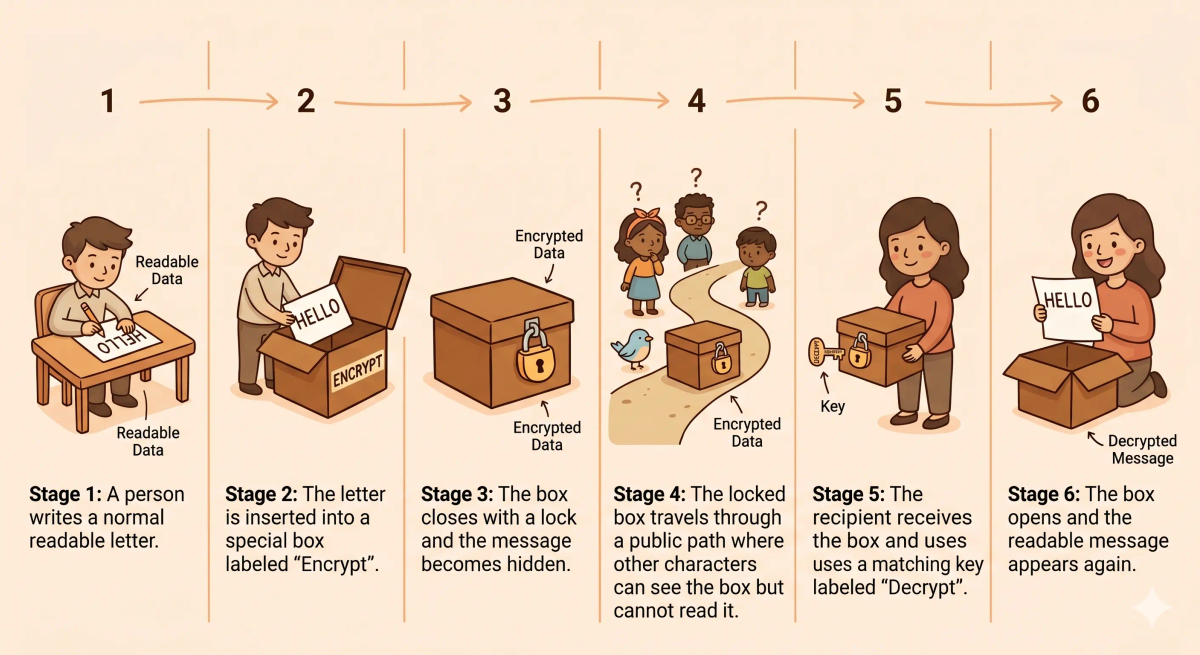
- You write a private letter.
- You place it into a locked box.
- The box travels across the delivery route.
- Other people may see the box, but they cannot read the message inside.
- Your friend receives the box.
- Your friend uses the correct key to open it and read the letter.
How It Works in the Real World
- A message or piece of data starts in normal readable form.
- Encryption transforms it into a scrambled unreadable form.
- The encrypted data travels or gets stored.
- If someone without the right key sees it, it still looks unreadable.
- The intended receiver uses the proper key to decrypt it.
- The original readable information appears again.
👉 That means encryption protects information by hiding its meaning unless the right key is used.
Real-World Example
Example: Opening a secure website
When you visit a secure website, such as online banking or a shopping site, your browser may send private information across the internet.
At that moment, HTTPS uses encryption to help protect information.
If everything matches the expected behavior, outsiders cannot easily read the private data while it travels.
If not, sensitive information would be much easier to expose during transmission.
What It Is Not
Encryption is not the same as…
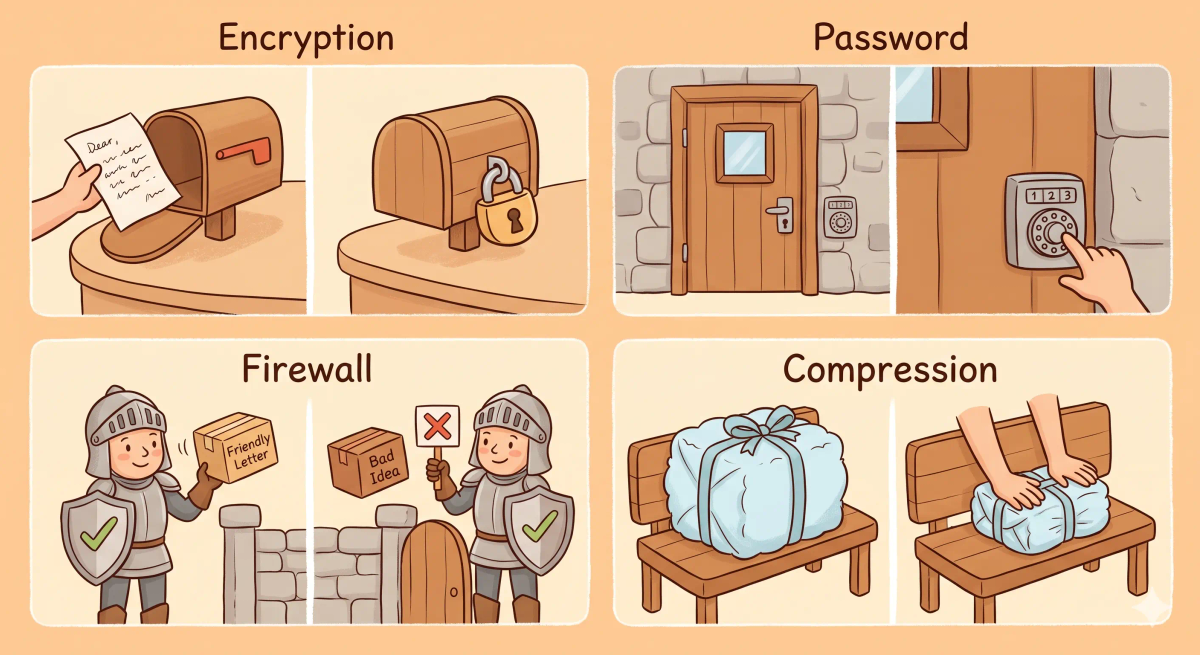
- A password — a password is one secret used for access, while encryption is the process of protecting the data itself
- A firewall — a firewall filters traffic, while encryption hides the content
- Compression — compression makes data smaller, while encryption makes data unreadable without the key
- VPN - A VPN often uses encryption, but a VPN is the private tunnel, not encryption itself.
So while these ideas are related, encryption specifically does data hiding through locking and unlocking.
Why It Matters
- It protects private information
- It helps secure websites, apps, and messages
- It reduces the risk of outsiders reading sensitive data
- It is a basic building block of online security
This matters because encryption is one of the main reasons private digital information can travel more safely across the internet.
The next time you hear that something is encrypted, remember that it means the information has been locked so only the right key can make sense of it.
A Slightly Deeper Version
A slightly deeper way to think about encryption is that it transforms readable data, often called plaintext, into an unreadable form, often called ciphertext, using a key and an algorithm.
Only someone with the correct key can decrypt the ciphertext back into readable information. That is why encryption is so important for secure communication and data protection.
On the web, encryption often works together with an SSL certificate, which helps your browser trust the website before a secure connection is created.
Common Questions
What is encryption in simple words?
Encryption is a way to scramble readable data so that it cannot be understood without the right key. In simple words, it turns a normal message into a secret code.
How does encryption work?
Encryption works by using a rule, called an algorithm, and a key to turn readable data into unreadable data. The correct key is needed to turn it back into something understandable.
Is encryption the same as a password?
No. A password is usually used to prove who you are or unlock access. Encryption is the process that changes data into a protected form so others cannot easily read it.
Is encryption used only on the internet?
No. Encryption is used on the internet, but it can also protect files, phones, laptops, messages, backups, payment details, and stored data.
Can encrypted data still be stolen?
Yes. Encrypted data can still be copied, stolen, or intercepted. But without the correct key, it is much harder for someone to understand what the data says.
What is an encryption key?
An encryption key is the secret piece of information used to lock or unlock encrypted data. You can think of it like the special key needed to read the scrambled message.
What is end-to-end encryption?
End-to-end encryption means a message is protected from the sender’s device to the receiver’s device. In many cases, only the sender and receiver should be able to read the message.
Why is encryption important?
Encryption is important because it helps protect privacy, passwords, messages, payments, personal files, and sensitive information when data is stored or sent.
In Short
- Encryption is like putting a secret letter inside a locked box
- Its job is to make information unreadable to outsiders
- It uses keys to lock and unlock the message
- It is different from passwords, firewalls, and compression
- It matters because it protects private data