 What Is a Socket? Explained Simply for Beginners
 Imagine you want to call someone in a huge office tower.
Just knowing the building is not enough.
You also need to know which exact phone extension inside that building to call.
If you only know the building address, your call might reach the right place but not the right person.
If you only know the extension, that is not enough either, because many buildings can have the same extension numbers inside them.
To reach the exact person, you need both pieces together.
That is the easiest way to start understanding a socket.
A socket is one endpoint of a network conversation, usually defined by an IP address, a port number, and a communication protocol.
Main Analogy
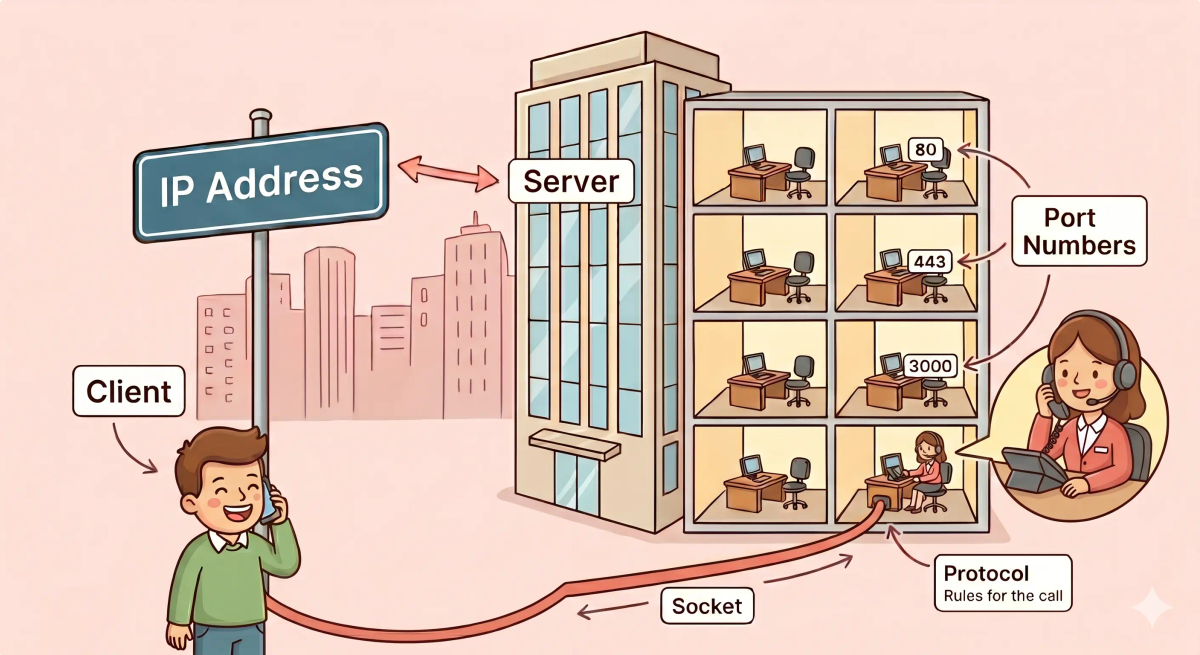
Think of a socket like a direct office phone line to one exact desk
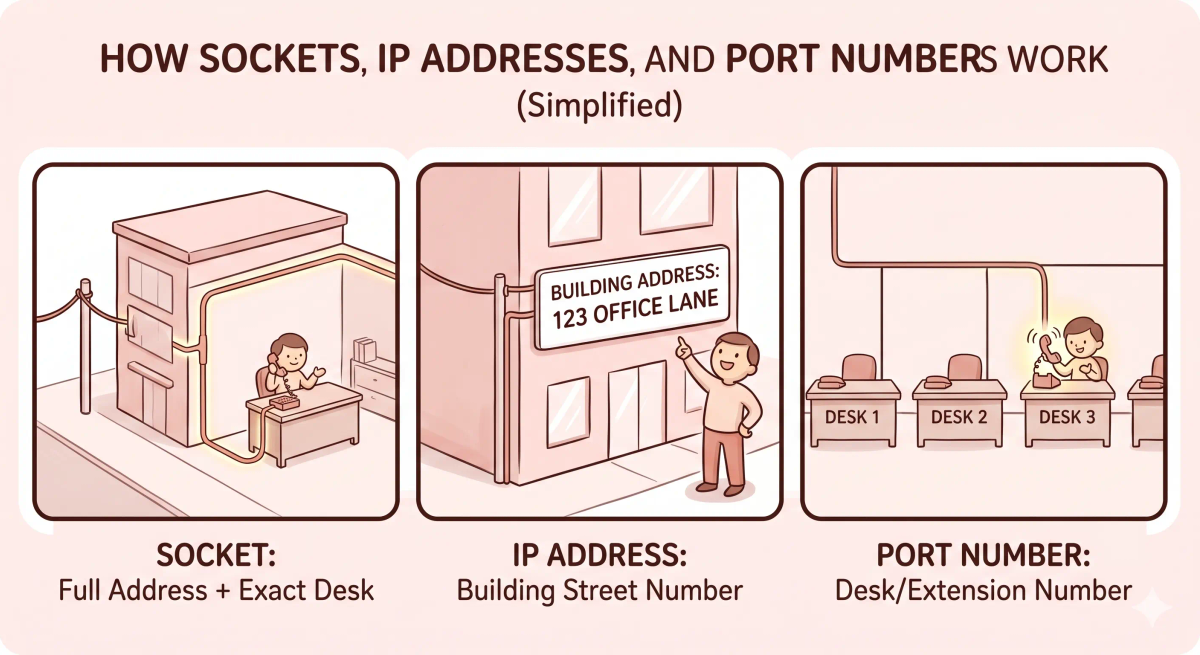
- IP address = the office building’s street address
- Port number = the phone extension or desk number inside the building
- Protocol = the calling style or rulebook for how the conversation happens
- Socket = the full direct line to one exact communication endpoint
So the easiest way to understand a socket is to think of it as the complete “reach this exact place for this exact conversation” point in a network.
What Problem Does It Solve?
If a huge office tower had only one front door and no desk numbers, phone extensions, or direct lines, it would be hard to reach the exact person you wanted.
The building might be correct, but the conversation would still not know where to go inside.
In the real world, computers need a precise way to direct communication not just to the right machine, but to the right service running on that machine.
So the job of a socket is to identify one exact endpoint for a network conversation.
How It Works in the Story
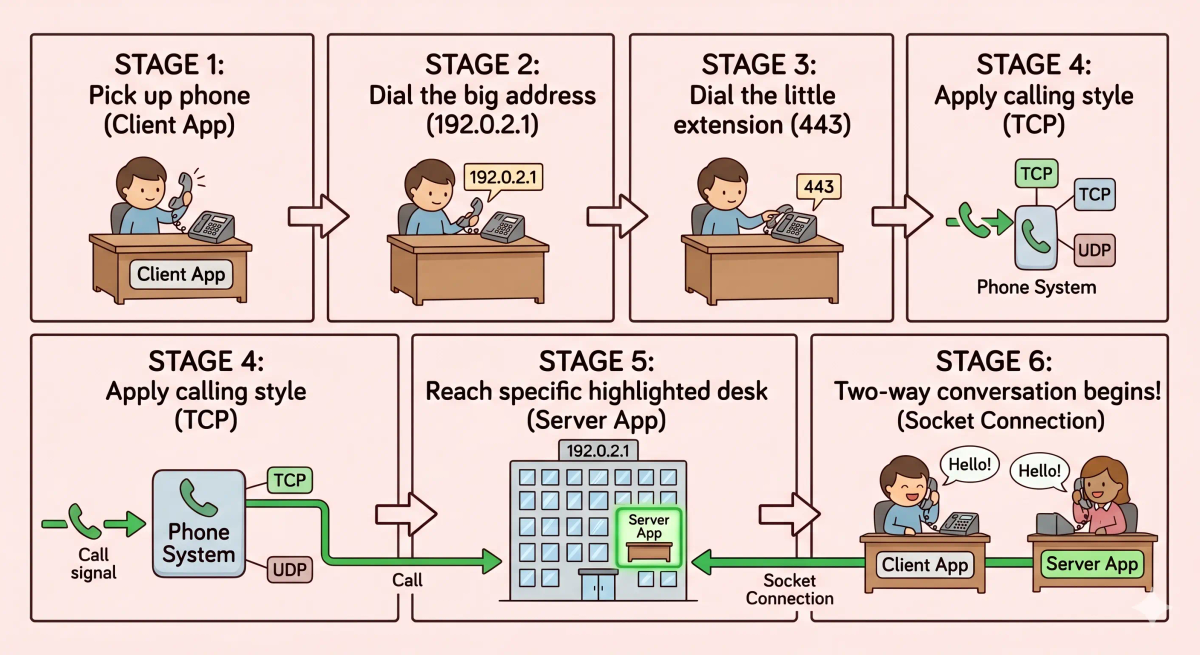
- You decide to call someone in a large office building.
- You look up the building address.
- You also look up the extension number for the correct desk.
- You use the correct calling rules to place the call.
- The phone system connects you to that exact desk.
- Now a real conversation can happen.
How It Works in the Real World
- A program wants to send or receive data across a network.
- It uses an IP address to identify the correct device.
- It uses a port number to identify the correct service on that device.
- It uses a protocol such as TCP or UDP to decide how the communication behaves.
- Together, these form a socket endpoint that can send or receive data.
👉 That means a socket helps a program communicate with one exact network endpoint.
Real-World Example
Example: Opening a webpage
When you open a webpage, your browser does not just reach a computer somewhere on the internet.
At that moment, it needs to reach the right service on that computer, often through a specific port using a specific protocol.
If everything matches the expected behavior, the browser reaches the correct service and the conversation begins.
If not, the connection may fail because the correct endpoint was not reached or was not listening.
What It Is Not
A socket is not the same as…
- IP address — an IP address identifies the machine, while a socket identifies the exact communication endpoint on that machine
- Port Number — a port number is only one part of a socket
- Protocol — the protocol describes the communication rules, but it is not the full endpoint by itself
- A cable or physical plug — in networking, a socket is a logical communication endpoint, not a physical wall socket
So while these ideas are related, a socket specifically does exact endpoint identification for communication.
Why It Matters
- It helps programs communicate with the right service
- It makes precise network conversations possible
- It connects apps, not just machines
- It is a basic building block of network communication
This matters because a socket is one of the concepts that turns raw networking into actual app-to-app communication.
The next time you hear that an app is “opening a socket,” remember that it is creating or using one exact conversation endpoint.
A Slightly Deeper Version
A slightly deeper way to think about a socket is that it is a software abstraction representing one endpoint of network communication.
In common networking discussion, a socket is associated with an IP address, a port, and a protocol. Programs use sockets to send and receive data between clients and servers.
That is why sockets are so important: they give software a practical way to talk across networks.
Common Questions
What is a socket in networking?
A socket is a software endpoint used for communication between two devices or programs on a network. In simple words, it is like a direct office phone line to one exact desk inside a huge building.
How does a socket work?
A socket works by combining details like an IP address, a port number, and a protocol so data knows exactly where to go and which app or service should receive it.
Is a socket the same as a port?
No. A port is only one part of a socket. A socket usually includes the IP address, the port number, and the protocol together.
What is the difference between a socket and a port?
A port is like a room number for a service on a device. A socket is the full communication endpoint, usually made from the device address, port number, and protocol.
Is a socket a physical thing?
No. In networking, a socket is not a physical plug or cable. It is a logical endpoint created and used by software.
Do websites use sockets?
Yes. Browsers and web servers use sockets underneath normal web activity so requests and responses can move between your device and the server.
What is the difference between a TCP socket and a UDP socket?
A TCP socket is used for reliable, connection-based communication, while a UDP socket is used for faster message-based communication with fewer delivery guarantees.
Can one computer have many sockets?
Yes. One computer can have many active sockets at the same time for different apps, browser tabs, background services, and network conversations.
In Short
- A socket is like a direct office phone line to one exact desk
- Its job is to identify one exact endpoint for communication
- It combines the right address, the right port, and the right protocol
- It is different from just an IP address or just a port number
- It matters because it helps apps talk to the exact service they need