 What Is UDP? Explained Simply for Beginners
 Imagine you are at a huge city marathon.
A race reporter needs to send quick updates to the giant screen near the finish line:
“Runner 12 is in front!”
“Now runner 8 is catching up!”
“Water station ahead!”
These updates need to move fast.
The reporter does not stop after every message and ask, “Did that note arrive?”
They do not resend every missed update.
They just keep sending the latest information as quickly as possible.
That is the easiest way to start understanding UDP.
UDP is a communication protocol that sends data quickly without checking that every piece arrived or arrived in order.
Main Analogy
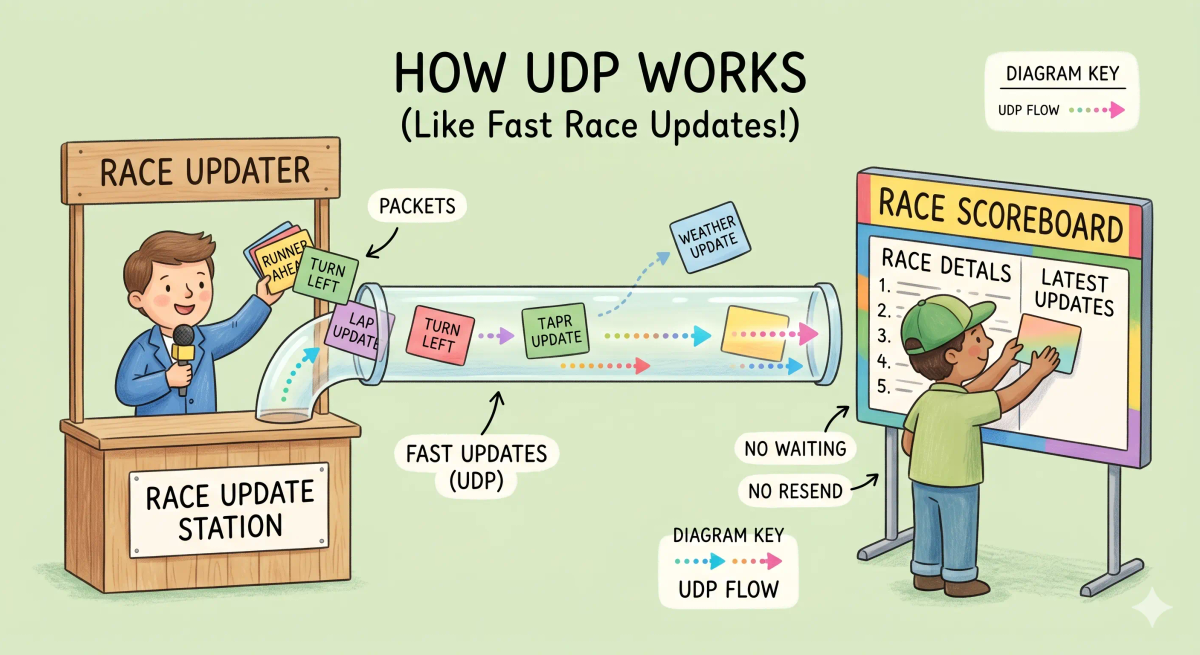
Think of UDP like a fast race reporter sending quick update cards
- Data = short race updates
- Packets = individual update cards
- UDP = the fast delivery style that sends updates immediately
- No acknowledgment = the reporter does not wait for “Yes, I got it”
- No resend = if one update card is lost, the reporter keeps going with the next one
So the easiest way to understand UDP is to think of it as a fast message system built for speed, not perfection.
What Problem Does It Solve?
If the race reporter stopped after every update and waited for a reply, the information would become old before it even reached the screen.
That would be a problem for things that need to feel live, immediate, and fast.
In the real world, some internet activities care more about speed than about making sure every single tiny piece is resent perfectly.
So the job of UDP is to send data with very little delay, even if that means some pieces may be missed or arrive out of order.
How It Works in the Story
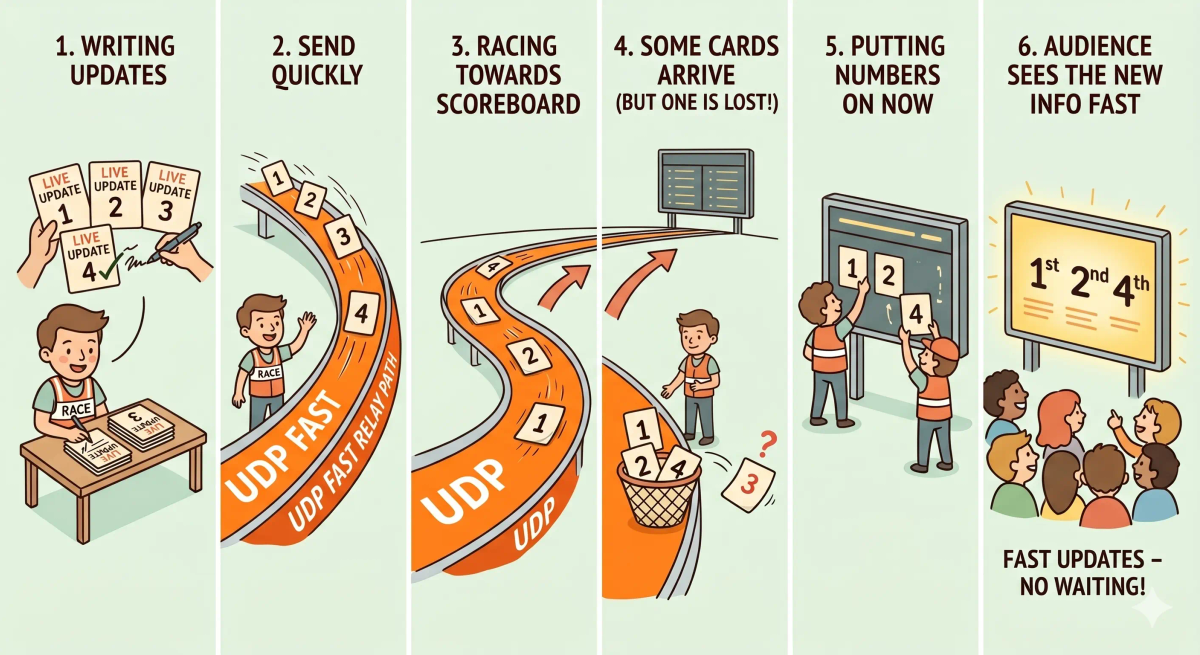
- The race reporter writes a quick update card.
- The card is sent immediately toward the scoreboard.
- The reporter sends the next update right away instead of waiting.
- Some cards arrive quickly.
- One card might be delayed or lost.
- The scoreboard still uses the newest update cards it receives.
- The race coverage stays fast and live.
How It Works in the Real World
- An app or service wants to send data quickly across a network.
- The data is split into small packets.
- UDP sends those packets out without setting up a heavy reliability system.
- The sender does not wait for confirmations for each packet.
- If a packet is lost, UDP itself usually does not resend it.
- The receiving side uses whatever packets arrive.
👉 That means UDP helps data move fast with very little overhead.
Real-World Example
Example: Online gaming or live voice chat
When you are in an online game or talking in a live voice call, speed matters a lot.
At that moment, UDP can be useful because the app wants the newest data right away. If one tiny sound packet or game update is lost, it is often better to keep moving than to pause and wait for the missing piece.
If everything matches the expected behavior, the experience feels fast and responsive.
If not, you may notice a tiny audio glitch, a skipped movement, or a brief jump, but the session continues.
What It Is Not
UDP is not the same as…
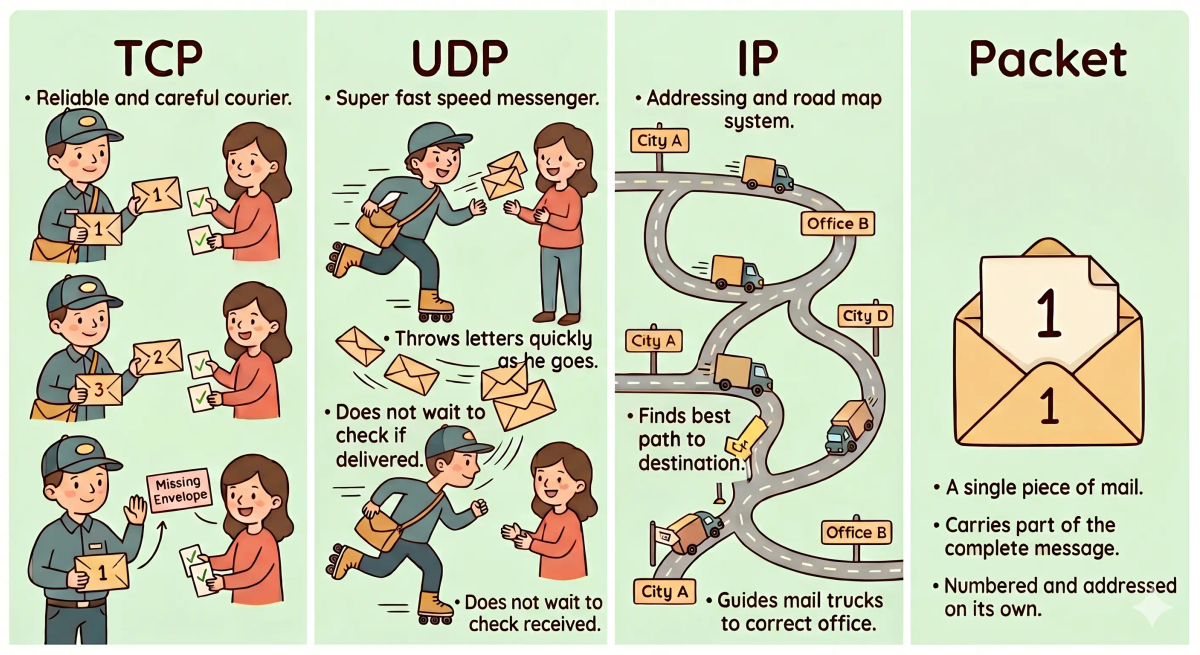
- TCP — TCP checks delivery, order, and missing pieces, while UDP focuses on speed with fewer checks
- IP Address — IP address helps packets find the destination, while UDP helps decide how those packets are sent at the transport level
- A packet — a data packet is one piece of data, while UDP is a protocol for sending many packets quickly
- HTTP — HTTP is a higher-level protocol often used for web communication, while UDP is a lower-level transport method
So while these ideas are related, UDP specifically does fast, lightweight delivery without built-in guarantees for every packet.
Why It Matters
- It helps live communication feel fast
- It reduces delay for time-sensitive apps
- It works well when the newest information matters more than perfect delivery
- It supports things like gaming, live audio, and some streaming systems
This matters because UDP is one of the tools that helps the internet feel real-time.
The next time you join a voice call or play an online game, remember that speed often matters more than making every tiny piece arrive perfectly.
A Slightly Deeper Version
A slightly deeper way to think about UDP is that it is a lightweight transport-layer protocol.
It sends datagrams with very little built-in checking. That means it does not provide the same delivery guarantees, ordering, or retransmission behavior that TCP does.
Because of that, UDP is often chosen for situations where lower delay is more important than perfect reliability.
Common Questions
What is UDP in simple words?
UDP is a protocol that sends data quickly without carefully checking every packet. In simple words, it is like a fast race reporter sending quick update cards instead of waiting to confirm every message arrived.
How does UDP work?
UDP works by sending small pieces of data, called packets, from one device to another without setting up a careful connection first. It sends quickly, but it does not check as much as TCP.
Is UDP faster than TCP?
Often yes. UDP is usually faster than TCP because it does less checking, has less overhead, and does not wait to confirm every packet before continuing.
What is the difference between UDP and TCP?
The main difference is that UDP focuses on speed, while TCP focuses on reliable delivery. UDP sends quickly with fewer checks, while TCP checks that data arrives correctly and in order.
Does UDP guarantee delivery?
No. UDP does not guarantee that packets arrive, arrive only once, or arrive in the correct order.
Why use UDP if it can lose data?
UDP is useful when speed matters more than perfect delivery. For live games, voice calls, video calls, and streaming, it can be better to miss a tiny piece than to pause everything while waiting.
What uses UDP?
UDP is often used by online games, voice calls, video calls, live streaming, DNS lookups, and other systems that need fast communication.
Is UDP good for gaming?
Yes. UDP is often good for online gaming because games need quick updates. If one small update is lost, the game can usually keep going instead of slowing down to resend every packet.
In Short
- UDP is like a fast race reporter sending update cards
- Its job is to move data quickly with very little delay
- It does not wait for confirmations or resend every missing piece
- It is different from TCP, IP, HTTP, and packets
- It matters because it helps real-time internet experiences feel fast