 What Is TCP? Explained Simply for Beginners
 Imagine you want to send a thick stack of important papers to a friend in another city.
You do not want any page to get lost.
You do not want page 7 to arrive before page 2 and create confusion.
And you definitely do not want your friend to miss a page without anyone noticing.
So instead of throwing all the pages loosely into the delivery system, you use a careful courier service.
That courier numbers every page, checks that everything arrived, and resends anything that went missing.
That is the easiest way to start understanding TCP.
TCP is a communication protocol that makes sure data packets are delivered reliably, in the right order, and without missing pieces.
Main Analogy
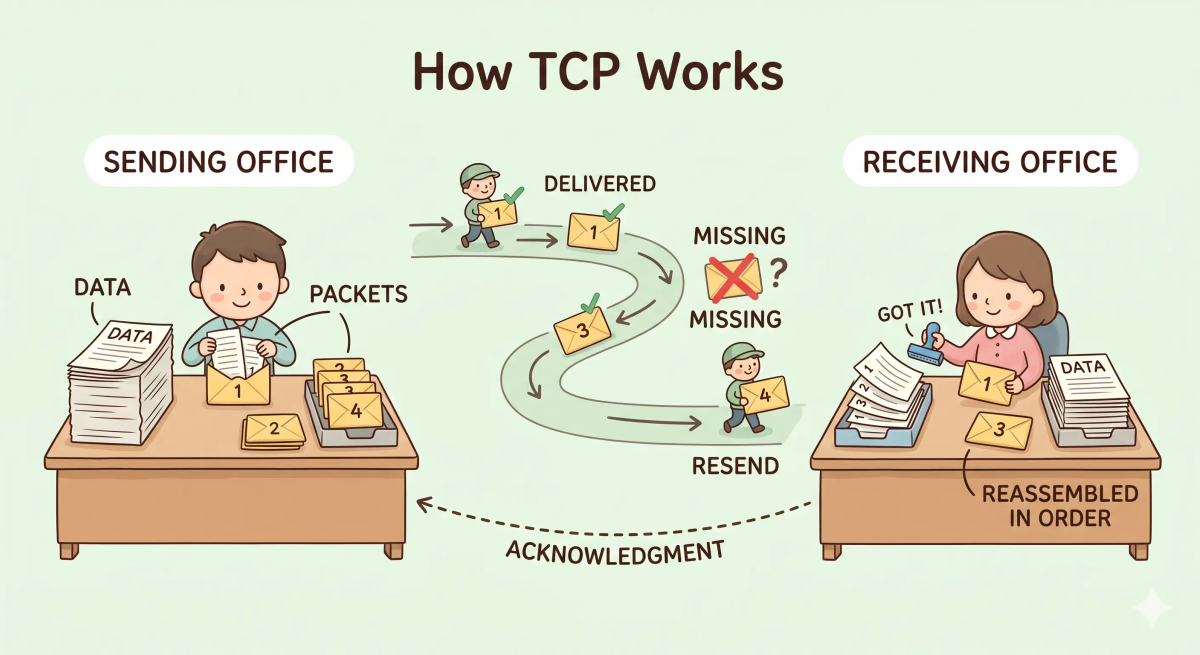
Think of TCP like a careful courier service for numbered pages
- Data = pages of an important document
- Packets = individual envelopes carrying those pages
- TCP = the careful courier system managing the delivery
- Acknowledgment = the receiver sending back “Yes, I got it”
- Resending = sending a missing page again if it never arrived
So the easiest way to understand TCP is to think of it as a system that sends many small pieces carefully, checks whether they arrived, and puts them back in the correct order.
What Problem Does It Solve?
If there were no careful courier service, pages could go missing, arrive out of order, or show up without anyone noticing that something was wrong.
That would be a problem for anything important, like contracts, school reports, or instructions that must stay complete and in order.
In the real world, data traveling across networks can also arrive late, out of order, or not arrive at all.
So the job of TCP is to make network communication more reliable by checking delivery, preserving order, and resending missing pieces when needed.
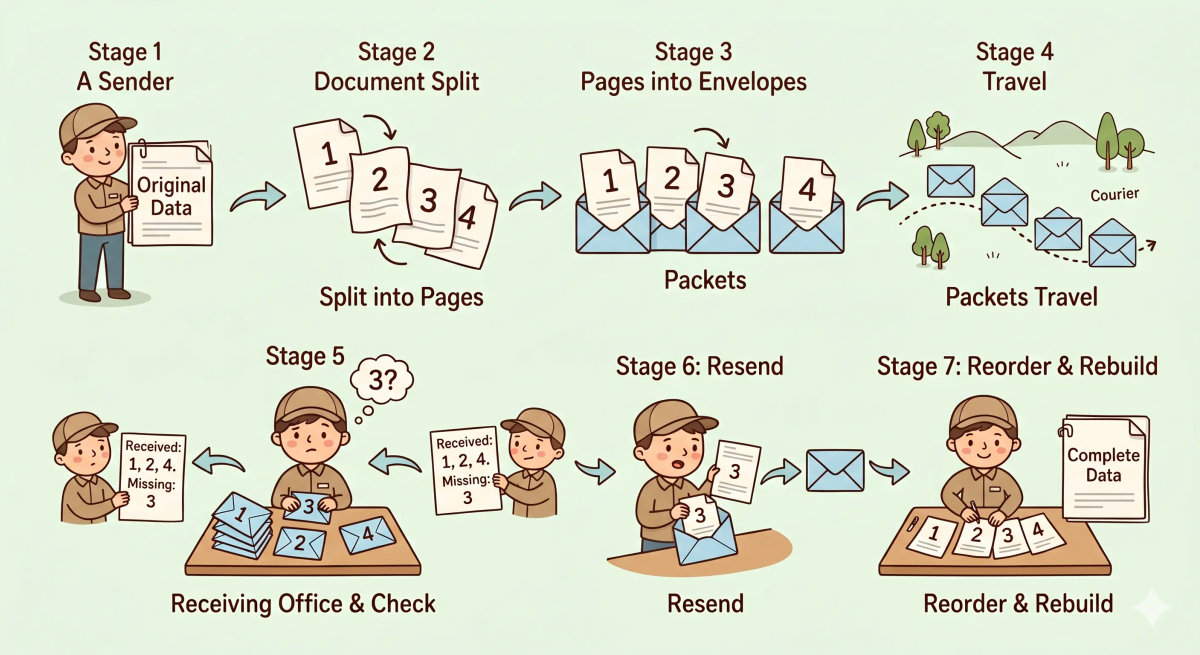
How It Works in the Story
- You split a big document into many small numbered pages.
- Each page is placed into its own envelope.
- The courier sends the envelopes out.
- The receiver checks which envelopes arrived.
- The receiver sends back confirmations for the pages that were received.
- If a page is missing, the sender sends that page again.
- The receiver places all the pages back in the correct order.
- The full document is complete and ready to read.
How It Works in the Real World
- A device wants to send a large piece of data across a network.
- The data is split into smaller pieces called packets.
- TCP numbers and tracks those packets during the transfer.
- The receiving side confirms which packets arrived.
- If some packets are missing, TCP arranges for them to be sent again.
- TCP also helps put the packets back in the correct order.
- The receiving application gets the full data as one complete, ordered stream.
👉 That means TCP helps data arrive reliably and in order.
Real-World Example
Example: Loading a webpage
When you open a webpage, your browser may need to receive many pieces of important data.
At that moment, TCP helps make sure those pieces arrive correctly and in order. If some network pieces are delayed or missing, TCP helps recover them instead of silently giving up.
If everything matches the expected behavior, the page loads properly.
If not, the connection may slow down while TCP waits, checks, and resends what is needed.
What It Is Not
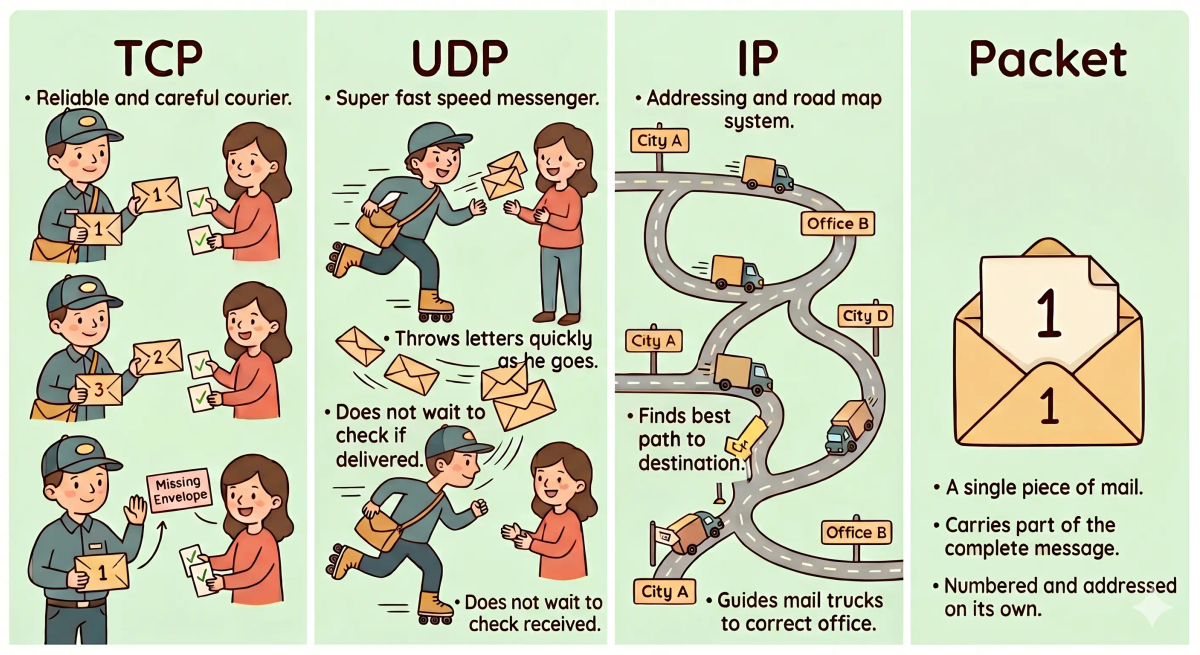
TCP is not the same as…
- UDP — UDP sends data faster with fewer checks, while TCP focuses on reliable and ordered delivery
- IP — IP helps get packets to the right destination, while TCP helps manage reliable delivery of those packets
- HTTP — HTTP is a higher-level web communication protocol, while TCP helps carry data underneath it
- A packet — a data packet is one small piece of data, while TCP is the system that manages how those pieces are delivered
So while these ideas are related, TCP specifically does reliable, ordered delivery with checks and resends.
Why It Matters
- It helps important data arrive completely
- It keeps data in the correct order
- It notices missing pieces and helps recover them
- It makes many internet activities feel dependable
This matters because TCP is one of the reasons things like web browsing, file downloads, and many online services work reliably.
The next time a page loads correctly or a file finishes downloading, remember that a careful system may be working in the background to keep the data complete and in order.
A Slightly Deeper Version
A slightly deeper way to think about TCP is that it is a transport-layer protocol that provides reliable, ordered, connection-based communication between devices.
TCP keeps track of sequence numbers, acknowledgments, retransmissions, and flow control so that data can arrive as a clean stream even if the underlying network is imperfect.
That is why TCP is often used when accuracy matters more than raw speed.
Common Questions
What is TCP in simple words?
TCP is a communication protocol that helps devices send data reliably. In simple words, it is like a careful courier service that numbers the pieces, checks that they arrive, and asks for missing pieces again.
How does TCP work?
TCP works by creating a connection, splitting data into smaller pieces, sending those pieces in order, checking that they arrive, and resending anything that gets lost.
Is TCP the same as the internet?
No. The internet is the larger network system. TCP is one protocol used on the internet to help data travel reliably between devices.
What is the difference between TCP and UDP?
TCP focuses on reliable and ordered delivery, while UDP focuses on speed with fewer checks. TCP is better when missing data would be a problem, while UDP is useful when speed matters more.
Is TCP better than UDP?
Not always. TCP is better for reliability, but UDP can be better for live games, calls, video streams, or other situations where waiting for every missing piece would slow things down.
Does TCP guarantee delivery?
TCP is designed to detect missing data and resend it, so it provides reliable delivery in normal network conditions. But no system can guarantee that nothing will ever go wrong.
What is a TCP three-way handshake?
A TCP three-way handshake is the connection setup step where two devices agree to start talking before sending data. It is like both sides saying, “Are you ready?”, “Yes, are you ready?”, and “Yes, let’s begin.”
Do websites use TCP?
Yes. Many websites use TCP underneath web protocols like HTTP and HTTPS, although some newer web technologies may use other transport protocols in specific cases.
In Short
- TCP is like a careful courier service for numbered pages
- Its job is to deliver data reliably and in the correct order
- It helps detect missing pieces and resend them
- It is different from UDP, IP, HTTP, and packets
- It matters because it makes many kinds of internet communication dependable