 What Is an IP Address? Explained Simply for Beginners
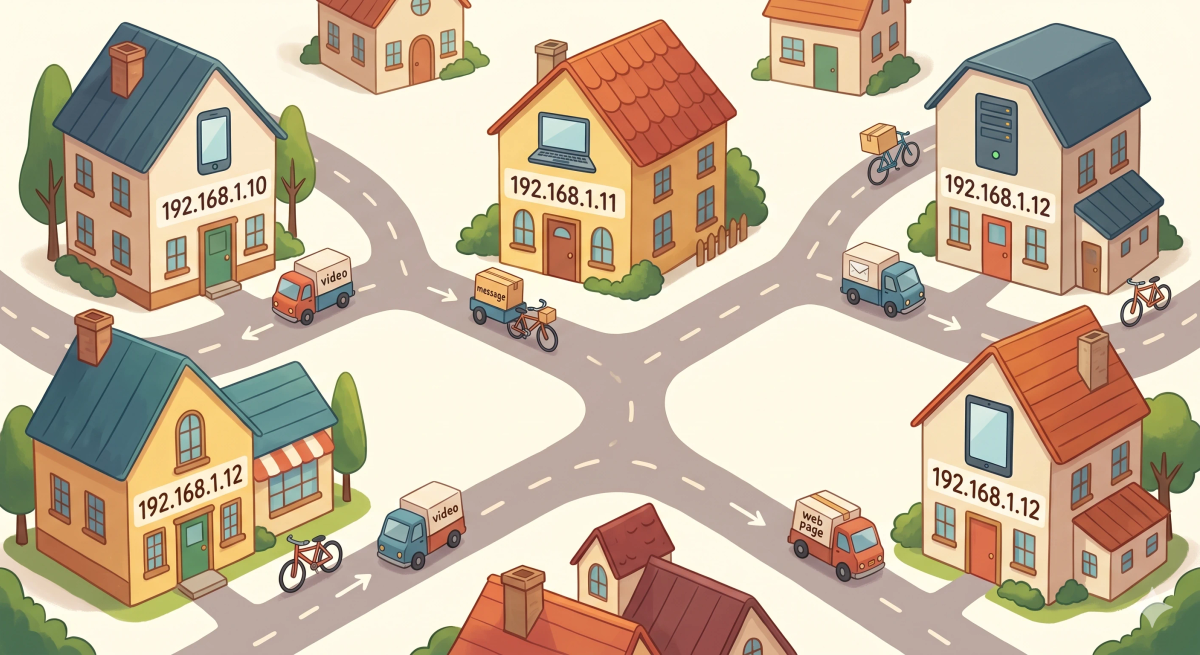
 Imagine a huge town filled with houses.
Every house has people inside waiting for letters, gifts, and visitors. But now imagine something strange: none of the houses have addresses.
There are roads everywhere. There are delivery vans everywhere. There are packages ready to be sent. But the drivers have no idea where any package should go.
One box says “send this video.” Another says “send this message.” Another says “send this website page.” But without an exact house address, everything gets lost.
That is the easiest way to start understanding an IP address.
An IP address is a unique number that identifies a device on a network so data knows where to go.
Main Analogy
Think of an IP address like a house address in a giant city
- Houses = devices like phones, laptops, and servers
- Roads = the internet or network connections
- Packages and letters = data
- House address = IP address
So the easiest way to understand an IP address is to think of it as the exact address that helps data find the right device.
What Problem Does It Solve?
If there were no house addresses, then every package truck in the town would be confused. The drivers would know there is a town full of houses, but they would not know which exact house should get the package.
In the real world, that means data could not reliably reach the right phone, laptop, or server.
So the job of an IP address is to give every device a usable location so data can be delivered to the right place.
How It Works in the Story
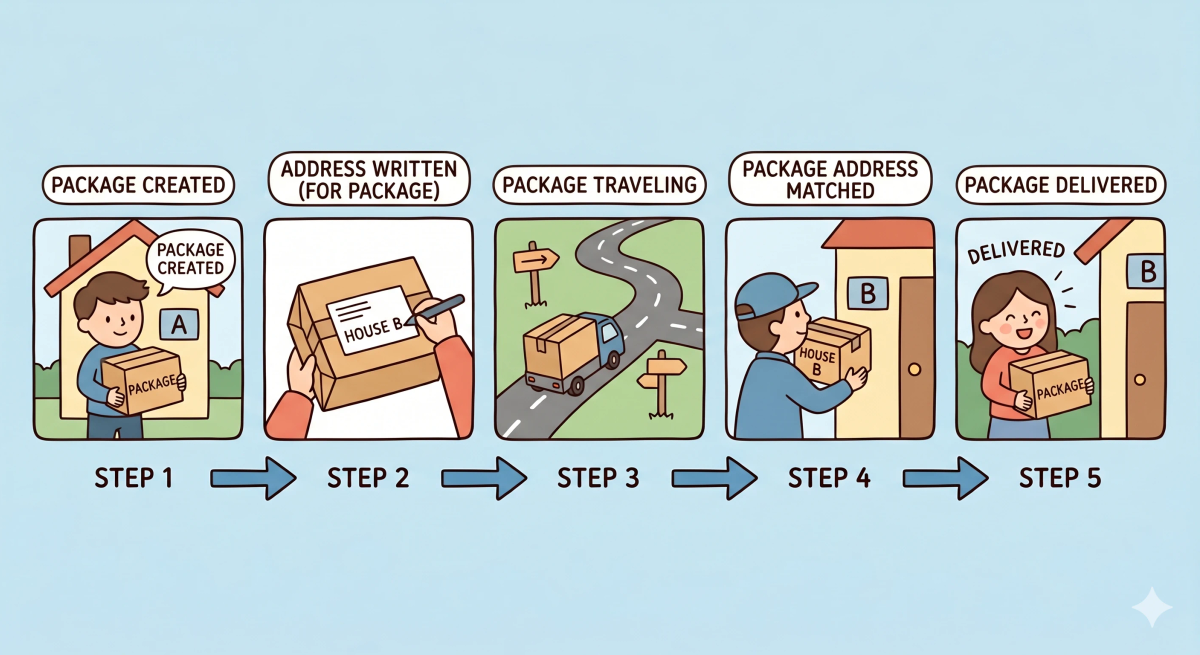
- Someone writes a package for a specific house.
- The delivery driver reads the address on the package.
- The driver follows the roads through the town.
- The driver looks for the exact numbered house.
- The package is delivered to the correct door.
How It Works in the Real World
- Your device sends or receives data across a network.
- That data includes destination information.
- Routers move the data across networks toward the right place.
- The destination IP address helps the data reach the correct device.
👉 That means an IP address helps data arrive at the right machine instead of getting lost.
Real-World Example
Example: Opening a website
When you open a website, your device sends a request asking for that page.
At that moment, the network needs to know where that request came from and where the response should go back.
The website’s server has its own IP address, and your device also has an IP address on the network it is using.
If everything is routed correctly, the website data comes back to your device.
If the destination information were missing or wrong, the data would not reach the right place.
What It Is Not
An IP address is not the same as…
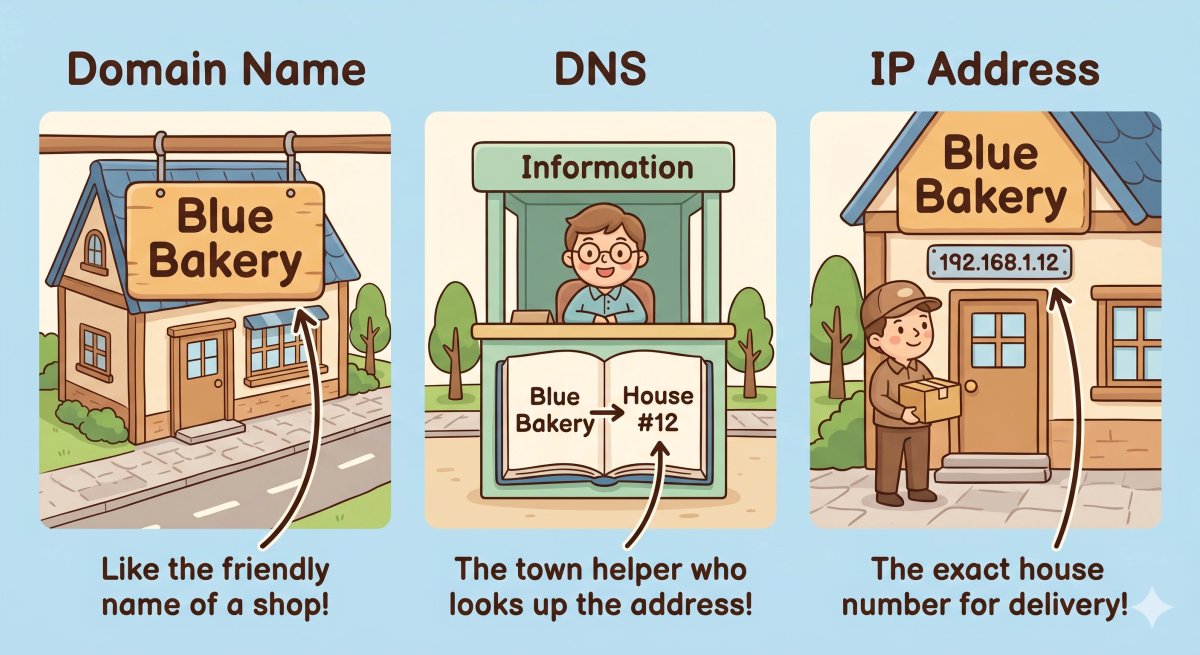
- Domain name — a domain name is the easy human name like google.com, while an IP address is the numeric network address machines use.
- DNS — DNS is the system that helps translate names into IP addresses.
- MAC address — a MAC address identifies hardware on a local network, while an IP address is used for network-level communication.
- URL — a URL points to a full web resource, while an IP address identifies a device or host on a network.
So while these ideas are related, an IP address specifically does the job of identifying where a device is on a network so data can be delivered.
Why It Matters
- It helps data reach the right device.
- It makes communication across networks possible.
- It allows websites, apps, and online services to send information back to you.
- It gives devices an identity on the network.
This matters because an IP address helps the internet know where things should be sent.
The next time you open a website, stream a video, or send a message, remember that behind the scenes, data still needs a precise address to find the right destination.
A Slightly Deeper Version
A slightly deeper way to think about an IP address is that it is a logical network address assigned to a device interface so other systems can send data to it.
Routers use IP information to move packets across networks, and protocols use source and destination IP addresses to know where traffic came from and where it should go.
That is why IP addressing is a core part of how the internet works.
Common Questions
What is an IP address in simple words?
An IP address is a number-based address that helps devices find and send data to each other on a network. In simple words, it is like a house address in a giant city.
What is an IP address used for?
An IP address is used to identify where data should go on a network. It helps websites, apps, routers, and devices send information to the right destination.
Does every device have an IP address?
Yes. Any device communicating on an IP network needs an IP address at that moment, whether it is a phone, laptop, server, printer, router, or smart device.
Is an IP address the same as a domain name?
No. A domain name is the human-friendly name, like a shop name. An IP address is the network address that devices use to find the right destination.
What is the difference between a public IP address and a private IP address?
A public IP address is used on the wider internet, while a private IP address is used inside a local network like your home Wi-Fi. Your router often connects the private side to the public side.
Do IP addresses change?
Yes, some IP addresses change and some stay stable. Many home internet connections use changing public IP addresses, while some servers use fixed or static IP addresses.
Can two devices have the same IP address?
Not on the same network at the same time. If two devices use the same IP address in the same network, it can cause confusion about where data should go.
Is my IP address private?
Not completely. Your public IP address can be visible to websites and services you connect to. Your private local IP address is usually only used inside your home or local network.
In Short
- An IP address is like a house address for a device
- Its job is to help data find the correct destination
- It helps phones, laptops, and servers communicate on networks
- It is different from a domain name or DNS
- It matters because the internet needs exact addresses to deliver information