 What Is the Internet? Explained Simply for Beginners
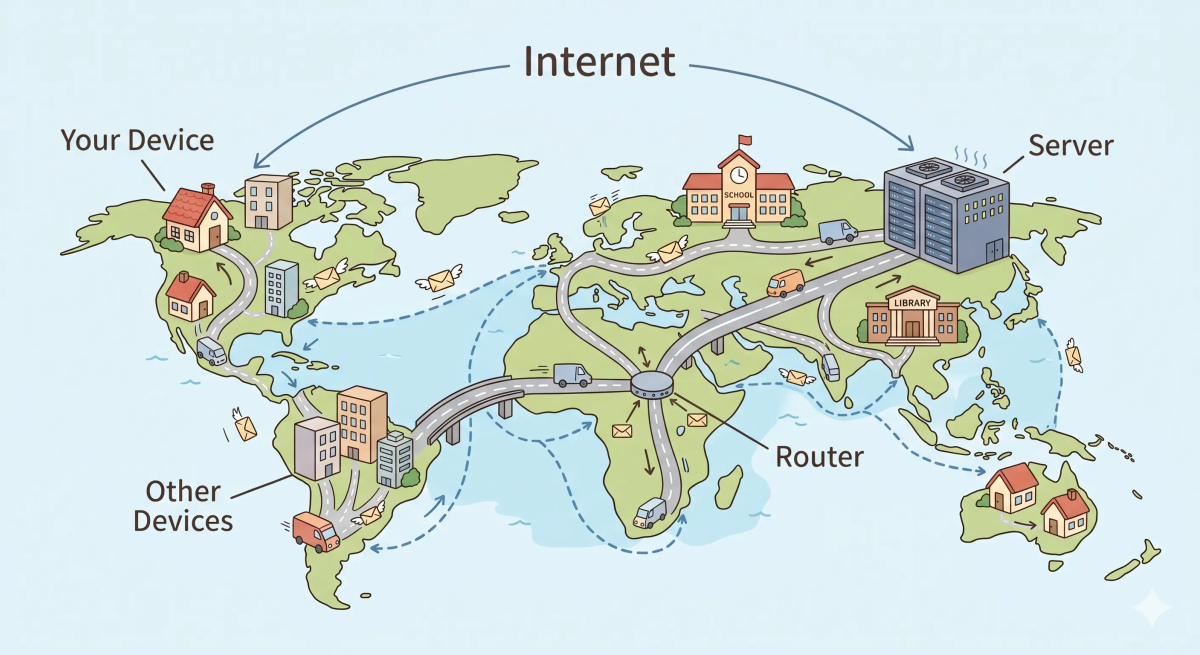
 Imagine the whole world is filled with towns, houses, schools, shops, and offices.
Now imagine that all of those places are connected by roads.
Some roads are small. Some are huge highways. Some lead to nearby places, while others stretch across countries and oceans.
Because all of these roads are connected, people can send letters, packages, and messages from one place to another.
That is the easiest way to start understanding the internet.
The internet is a giant global network that connects computers and devices so they can send and receive information.
Main Analogy
Think of the internet like a huge world of connected roads
- Computers and devices = houses and buildings
- Data = letters, parcels, and deliveries
- Routers and network equipment = road signs, intersections, and sorting points
- The internet = the full road system connecting places together
So the easiest way to understand the internet is to think of it as a giant connected road system that lets information travel between devices all over the world.
What Problem Does It Solve?
If there were no connected road system, each town would feel cut off from every other town.
You might be able to move around your own street, but sending something far away would be hard or impossible.
In the real world, that means your phone, laptop, or smart TV would not be able to reach websites, apps, videos, or other devices in different places.
So the job of the internet is to connect distant devices and make communication possible between them.
How It Works in the Story
- Many houses and buildings exist in different places.
- Roads connect those places together.
- A person in one house wants to send a message or package.
- The package moves through roads, intersections, and route signs.
- It reaches the correct building.
- That building can send something back in return.
How It Works in the Real World
- Many devices exist around the world, such as phones, laptops, routers, and servers.
- Networks connect these devices together.
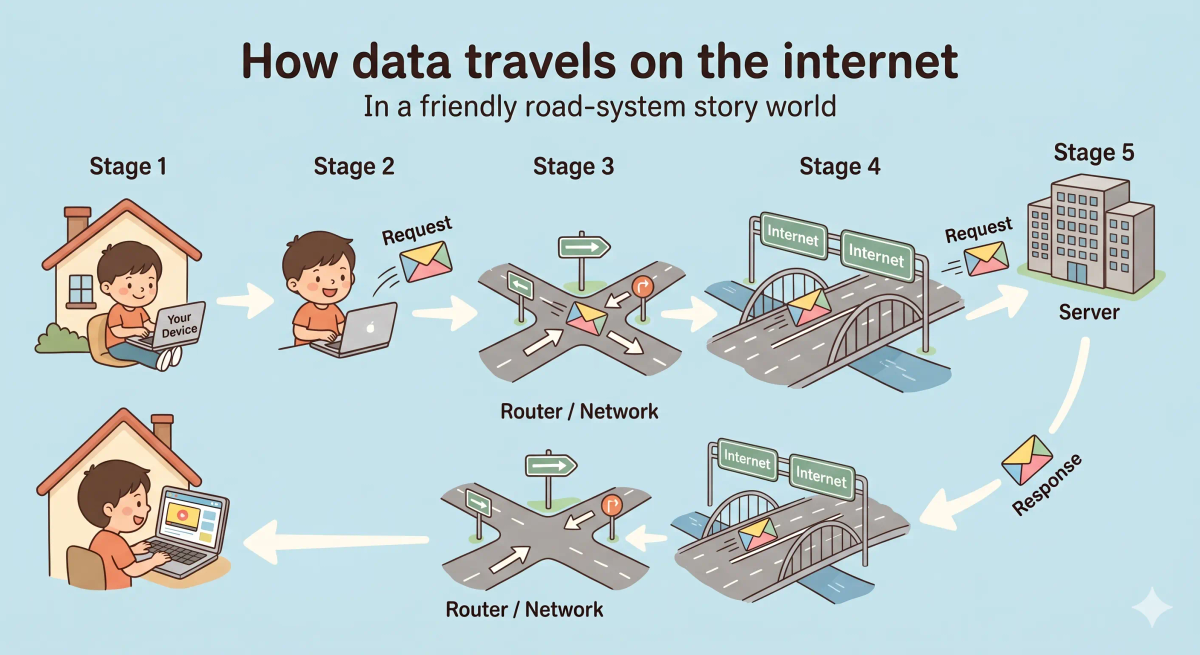
- When one device wants information, it sends data out into the network.
- That data travels through connected systems until it reaches the right destination.
- The destination sends back a response.
- The original device receives the information it asked for.
👉 That means the internet helps devices communicate across distance.
Real-World Example
Example: Watching a video online
When you tap a video on your phone, your device needs to ask another computer for that video.
At that moment, the internet carries that request out across connected networks. The video data then comes back to your phone in many small pieces.
If everything works normally, the video starts playing.
If the connection is weak or slow, the video may pause or buffer because the data is still traveling.
What It Is Not
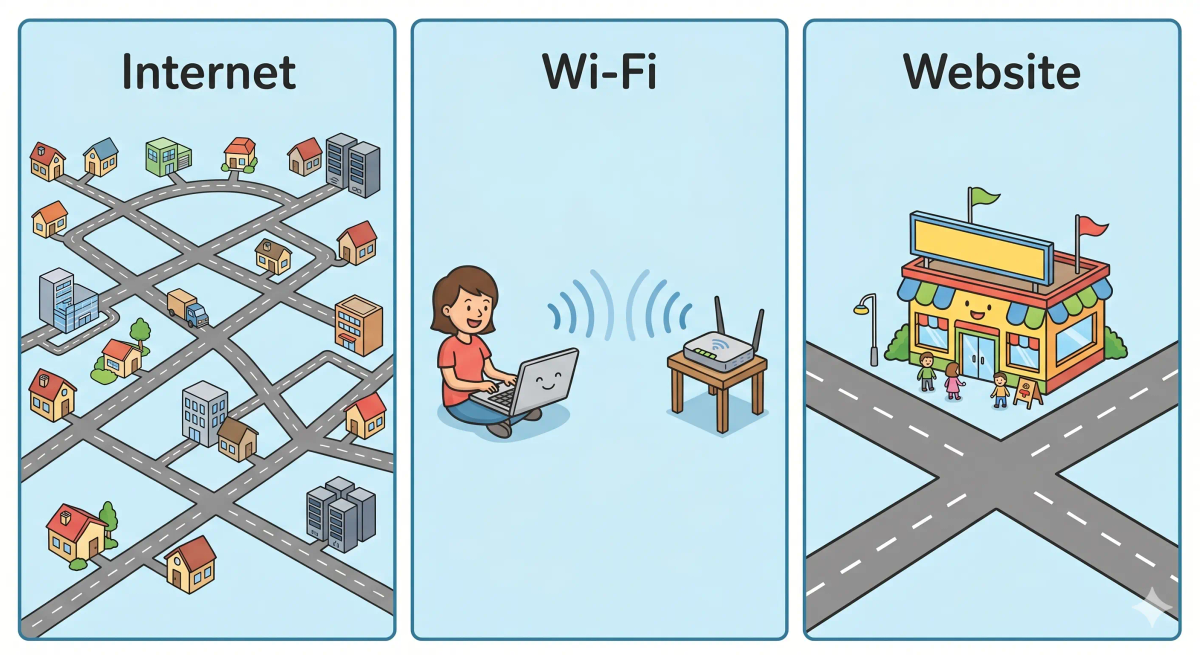
The internet is not the same as…
- Wi-Fi — Wi-Fi is just one way your device connects to a nearby network
- A website — a website is something you use on the internet, not the whole system
- A browser — a browser is the tool you use to open web pages
- A Server — a server is one computer on the internet, not the entire network
So while these ideas are related, the internet specifically does the connecting.
Why It Matters
- It lets people communicate across the world
- It makes websites, apps, games, and videos possible
- It helps businesses, schools, and services stay connected
- It allows information to move quickly between devices
This matters because the internet is the system that makes modern digital life possible.
The next time you open a website, send a message, or watch a video, remember that the internet is the giant connected path making that journey possible.
A Slightly Deeper Version
A slightly deeper way to think about the internet is that it is a network of networks.
Instead of being one single thing owned by one person, it is made up of many separate networks connected together. These networks use shared rules to move data between devices.
That is why your phone can reach a server in another city or even another country.
Common Questions
What is the internet in simple words?
The internet is a huge global network that connects devices, servers, and smaller networks around the world. In simple words, it is like a giant system of roads that lets information travel from one place to another.
How does the internet work?
The internet works by breaking information into small pieces, sending those pieces across connected networks, and putting them back together at the destination. Routers, servers, cables, wireless links, and protocols all help move the data.
Is the internet the same as Wi-Fi?
No. Wi-Fi is just a wireless way for your device to connect to a nearby network. The internet is the much bigger global network that your Wi-Fi network may connect to.
Is the internet the same as the web?
No. The web is one service that runs on top of the internet. The internet is the larger system that carries data for websites, apps, email, games, video calls, and many other services.
Do I need the internet to use websites?
Yes, if the website is online. Your device uses the internet to reach the server that stores or runs the website.
Can the internet work without Wi-Fi?
Yes. Wi-Fi is only one way to connect. You can also use the internet through Ethernet, mobile data, fiber, cable, satellite, or other network connections.
Why is my internet slow?
The internet can feel slow because of weak Wi-Fi, low bandwidth, high latency, network congestion, router problems, provider issues, or a slow server on the other end.
Who owns the internet?
No single person or company owns the entire internet. It is made of many connected networks run by internet providers, companies, governments, universities, data centers, and organizations around the world.
In Short
- The internet is like a giant world of connected roads
- Its job is to connect devices and let information travel between them
- It helps requests and responses move across long distances
- It is different from Wi-Fi, websites, browsers, and servers
- It matters because it powers so much of modern digital life