 Authentication vs Authorization Explained Simply for Beginners
 If these two words feel almost identical, this page will help you separate them clearly.
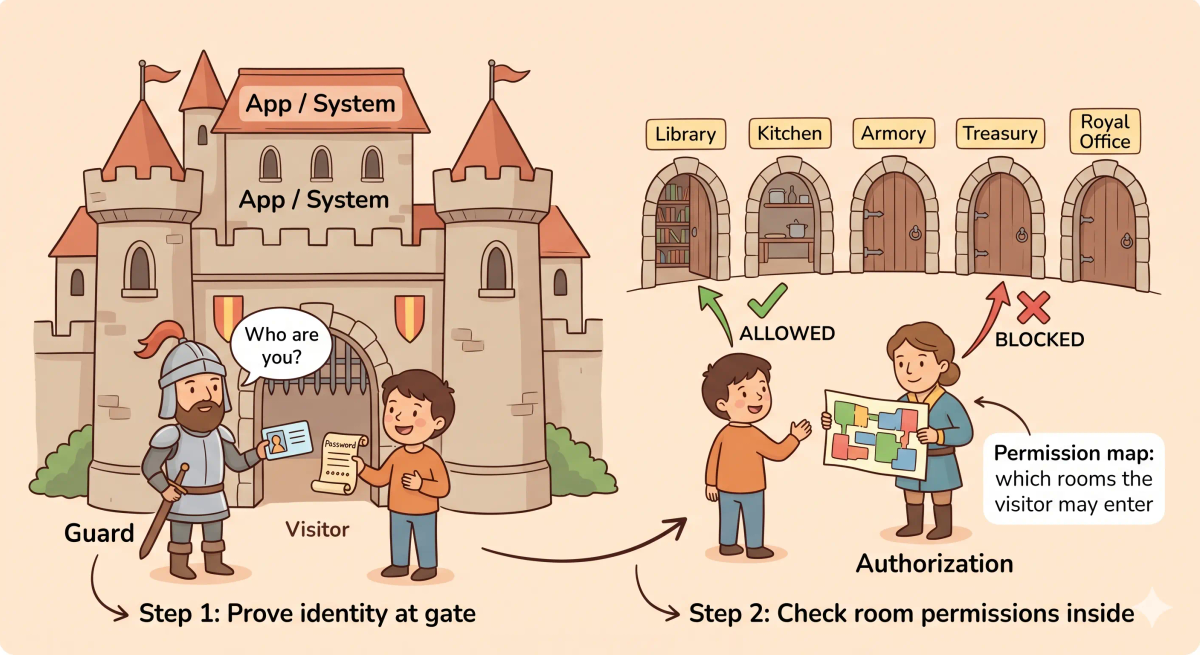
Authentication is like proving your identity at the castle gate.
Authorization is like being told which rooms inside the castle you are allowed to enter.
So the main difference is simple:
- Authentication checks who you are.
- Authorization checks what you are allowed to do.
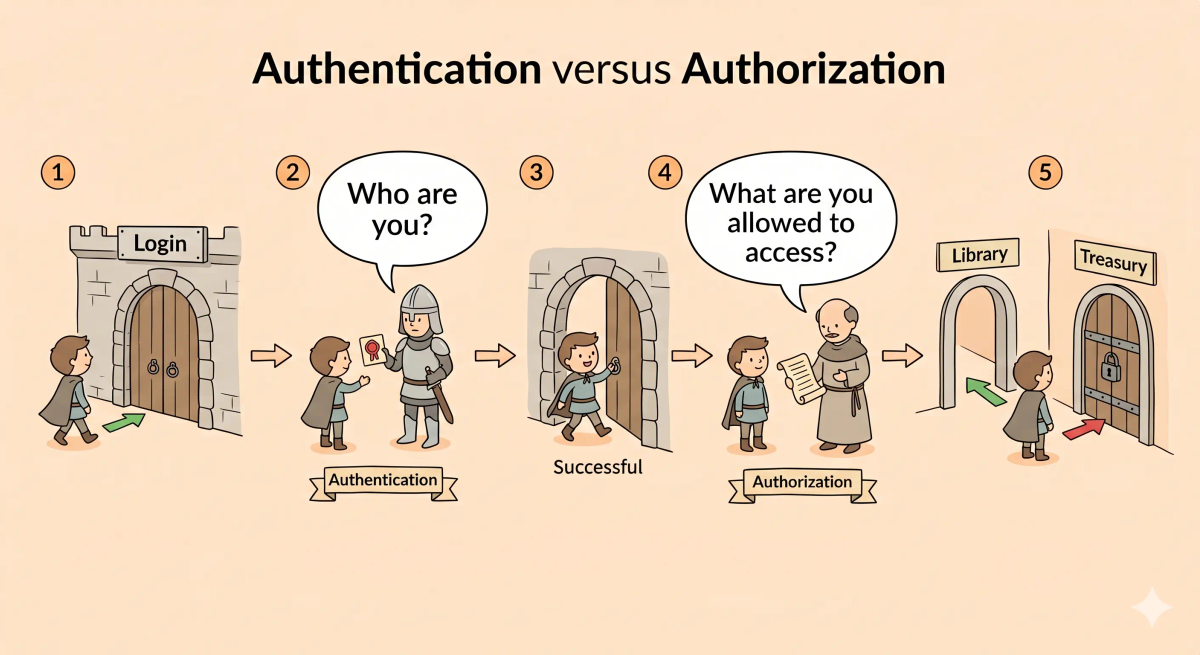
If you only remember one thing, remember this: authentication asks “Who are you?”; authorization asks “What are you allowed to access?”
Quick Comparison Table
| Feature | Authentication | Authorization |
|---|---|---|
| Main question | Who are you? | What are you allowed to access? |
| Simple analogy | Showing your identity at the castle gate | Getting permission to enter certain castle rooms |
| Happens when | You log in or prove identity | After identity is known |
| Uses | Passwords, OTPs, biometrics, login tokens | Roles, permissions, access rules, policies |
| Example | “This is really Alice.” | “Alice can enter the library, but not the treasury.” |
| Main failure | Wrong identity proof | Not enough permission |
| Memory shortcut | Identity check | Permission check |
Story Hook
Imagine a large castle.
Many people arrive at the castle gate: knights, cooks, royal advisors, guests, merchants, and guards. The castle cannot let everyone walk in without checking who they are.
But checking identity is only the first step.
Even after someone proves who they are, that does not mean they can enter every room. A cook may enter the kitchen. A librarian may enter the library. A royal treasurer may enter the treasury.
So the castle needs two separate checks.
First, it must ask: Who are you?
Then, it must ask: What are you allowed to access?
That is the easiest way to start understanding authentication vs authorization.
Main Analogy
Think of authentication and authorization like castle access control
- User = person trying to enter the castle
- Login page = castle gate checkpoint
- Password, OTP, fingerprint, or passphrase = identity proof
- Authentication = proving who you are at the gate
- Roles and permissions = room access rules inside the castle
- Authorization = deciding which rooms, tools, or records you can use
- Protected data or features = castle rooms like the library, armory, treasury, or royal office
So the easiest way to understand this comparison is:
- Authentication = identity check
- Authorization = permission check
What Problem Does Each One Solve?
Authentication
In the castle story, authentication solves the “is this person really who they claim to be?” problem.
If someone says, “I am the royal librarian,” the guard should not simply believe them. The guard needs proof: a badge, a seal, a passphrase, or a trusted identity document.
In the real world, authentication checks a user’s identity. This may happen through a password, one-time code, fingerprint, face scan, security key, or login token.
Authorization
In the castle story, authorization solves the “what is this person allowed to do?” problem.
Even if someone truly is the royal librarian, that does not mean they can enter the treasury, command the guards, or open the king’s private office.
In the real world, authorization checks permissions. It decides whether an authenticated user can access a page, use a feature, edit a record, delete a file, or perform an action.
The actual difference
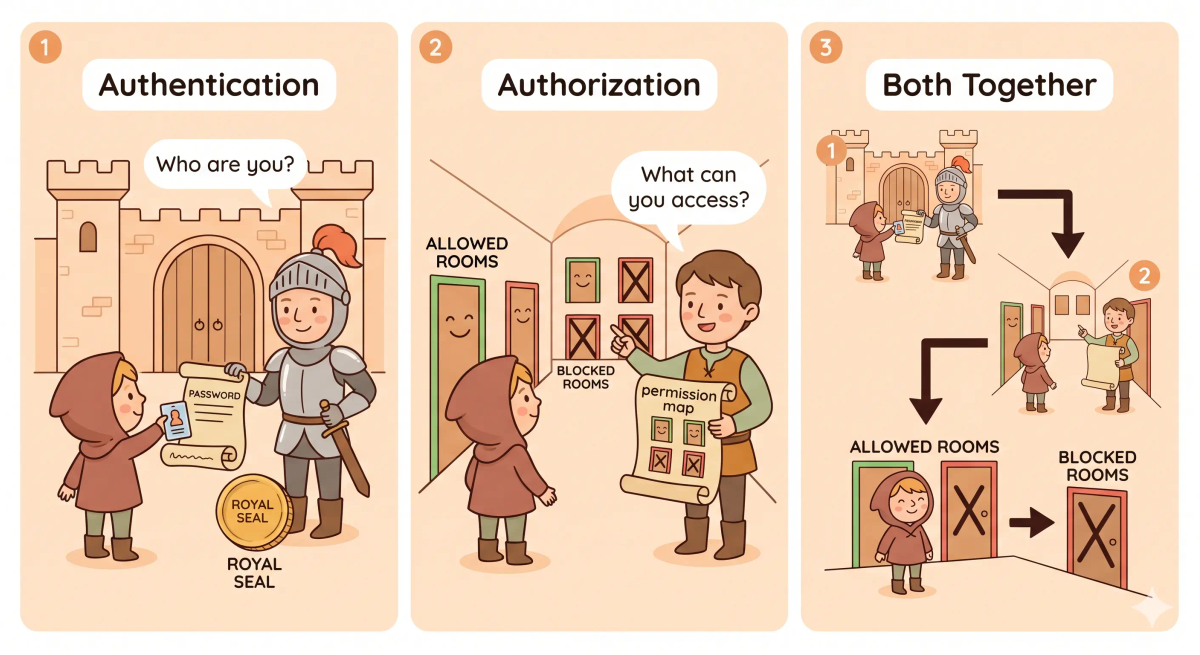
In the story world, authentication proves the visitor’s identity at the castle gate, while authorization decides which rooms the visitor may enter inside the castle.
In the real world, that means authentication verifies who the user is, while authorization controls what that user can access.
So the actual difference is that authentication is about identity, whereas authorization is about permission.
How the Difference Works in the Story
Authentication in the story
- A visitor arrives at the castle gate.
- The guard asks for proof of identity.
- The visitor shows a badge, royal seal, password scroll, or secret phrase.
- The guard checks whether the proof is valid.
- If the proof is correct, the visitor is allowed into the castle.
Authorization in the story
- The visitor is now inside the castle.
- The permission steward checks the visitor’s role.
- The steward looks at the castle access rules.
- The visitor is allowed into some rooms and blocked from others.
- The visitor can only do what their role permits.
How the Difference Works in the Real World
Authentication in the real world
- A user enters a username, password, OTP, fingerprint, or other identity proof.
- The system checks whether that proof matches a trusted record.
- If the proof is valid, the system knows who the user is.
- The user is considered logged in or authenticated.
Authorization in the real world
- The system already knows who the user is.
- The user tries to access a page, file, API, button, or action.
- The system checks roles, permissions, ownership, or policy rules.
- If the user has permission, access is allowed.
- If the user lacks permission, access is denied.
👉 That means authentication usually happens first, and authorization happens after the system knows who you are.
Real-World Example
Example: Logging into a learning app
Imagine you log into a learning app.
When you enter your email and password, the app performs authentication. It checks whether you are really the account owner.
After login, you try to open different areas of the app. You may be allowed to view your own lessons, but not the admin dashboard. That second check is authorization.
In the castle story, authentication gets you through the main gate. Authorization decides whether you can enter the library, the armory, or the treasury.
That is why the difference matters in practice.
The Difference Mapped Clearly
Authentication
- Checks identity
- Usually happens during login
- Uses things like passwords, OTPs, biometrics, or security keys
- Answers: “Who is this user?”
- Is like proving your identity at the castle gate
Authorization
- Checks permissions
- Usually happens after authentication
- Uses roles, access rules, policies, ownership, or permission levels
- Answers: “What can this user access or do?”
- Is like checking which castle rooms your role allows you to enter
Mental shortcut: authentication = identity, authorization = permission.
What Authentication and Authorization Are Not
This comparison is not the same as…
- Password — a password is one possible proof used for authentication, not authentication itself.
- Two-factor authentication — 2FA is a stronger form of authentication, not authorization.
- Firewall — a firewall controls network traffic, while authentication and authorization control user identity and access.
- Encryption — encryption hides information so others cannot read it, but it does not decide who you are or what you can access.
So while these ideas are related, the unique job of this comparison is understanding identity checking versus permission checking.
Why the Difference Matters
- It helps you understand how login systems work.
- It helps you debug access problems more clearly.
- It helps explain why being logged in does not mean you can access everything.
- It is a key idea in web security, app development, DevOps, and cloud systems.
This matters because authentication and authorization are often shortened together as “auth,” but they solve different security problems.
A memorable closer: the next time you hear authentication or authorization, remember the castle: first prove who you are, then check where you are allowed to go.
A Slightly Deeper Version
A slightly deeper way to think about this comparison is that authentication establishes a user’s identity, while authorization evaluates access rules for that identity.
They may seem similar because both are part of access control, but the real distinction is that authentication creates trust in who the user is, while authorization applies rules to what that user can do.
For example, a system might authenticate you as [email protected], then authorize you to view your own profile but not another user’s private records.
Common Questions
Is authentication the same as authorization?
No. Authentication checks identity, while authorization checks permission.
Which happens first: authentication or authorization?
Authentication usually happens first. The system needs to know who you are before it can decide what you are allowed to access.
Can you have authentication without authorization?
Yes. A system may verify who you are, but still need separate permission rules to decide what you can do.
Can you have authorization without authentication?
Sometimes systems allow public access using general rules, but for user-specific permissions, authorization usually depends on authentication.
Is a password authentication or authorization?
A password is used for authentication. It helps prove who you are.
Why do people confuse authentication and authorization?
Because both are part of access control and are often discussed together. But authentication is about identity, while authorization is about permissions.
In Short
- Authentication is like proving your identity at the castle gate
- Authorization is like checking which castle rooms you may enter
- The main difference is that authentication checks who you are, while authorization checks what you can access
- Authentication usually happens before authorization
- Both are needed for secure systems