 What Is a Firewall? Explained Simply for Beginners
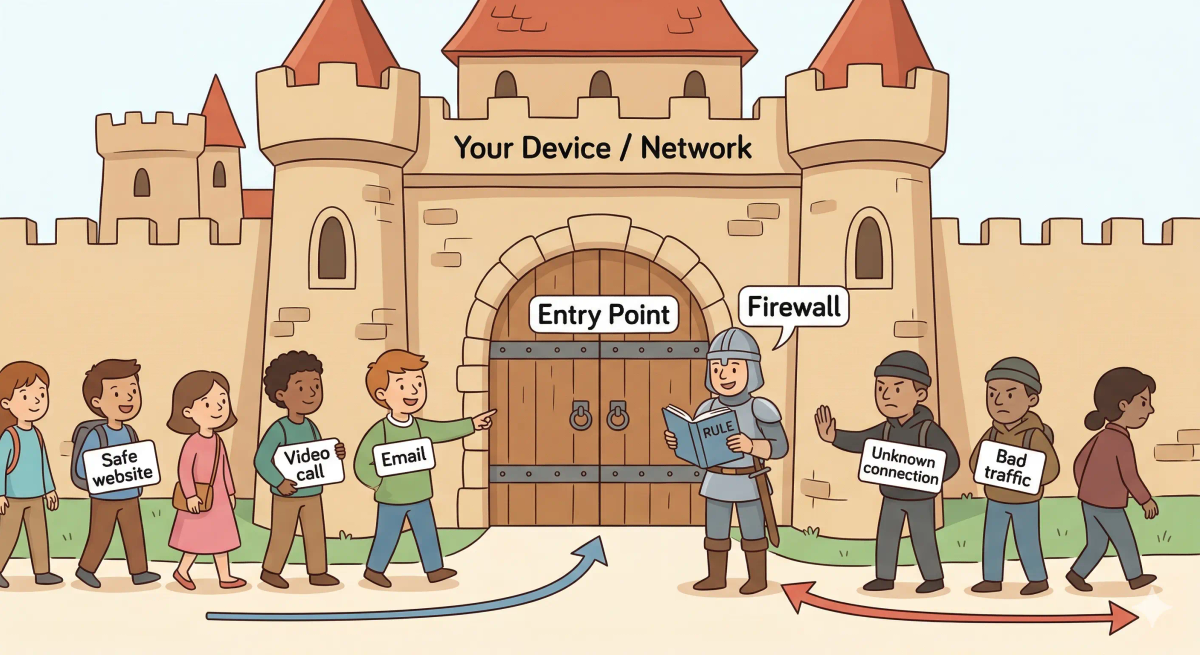
 Imagine a big castle with one main gate.
Lots of people want to come in. Some are friendly visitors. Some are delivery workers. Some may be troublemakers pretending to be nice.
So how does the castle stay safe without locking out everyone?
It puts a smart guard at the gate.
That is exactly where a firewall comes in.
A firewall is a security system that checks incoming and outgoing network traffic and decides what should be allowed or blocked.
Main Analogy
Think of a firewall like a guard at a gate
- Castle = your computer or network
- Gate = the point where traffic enters or leaves
- Visitors = data coming in and out
- Guard = the firewall
- Rulebook = firewall rules
So the easiest way to understand a firewall is to think of it as a gate guard that checks who can enter and who must stay out.
What Problem Does It Solve?
If there were no guard at the gate, anybody could walk into the castle.
In the real world, that means dangerous or unwanted network traffic could reach your computer, app, or company network more easily.
So the job of a firewall is to filter traffic and reduce the chance of harmful or unwanted connections getting through.
How It Works in the Story
- A visitor walks up to the castle gate.
- The guard checks the rulebook.
- The guard looks at who the visitor is and why they are there.
- If the visitor matches the rules, the guard opens the gate.
- If the visitor breaks the rules, the guard blocks them.
How It Works in the Real World
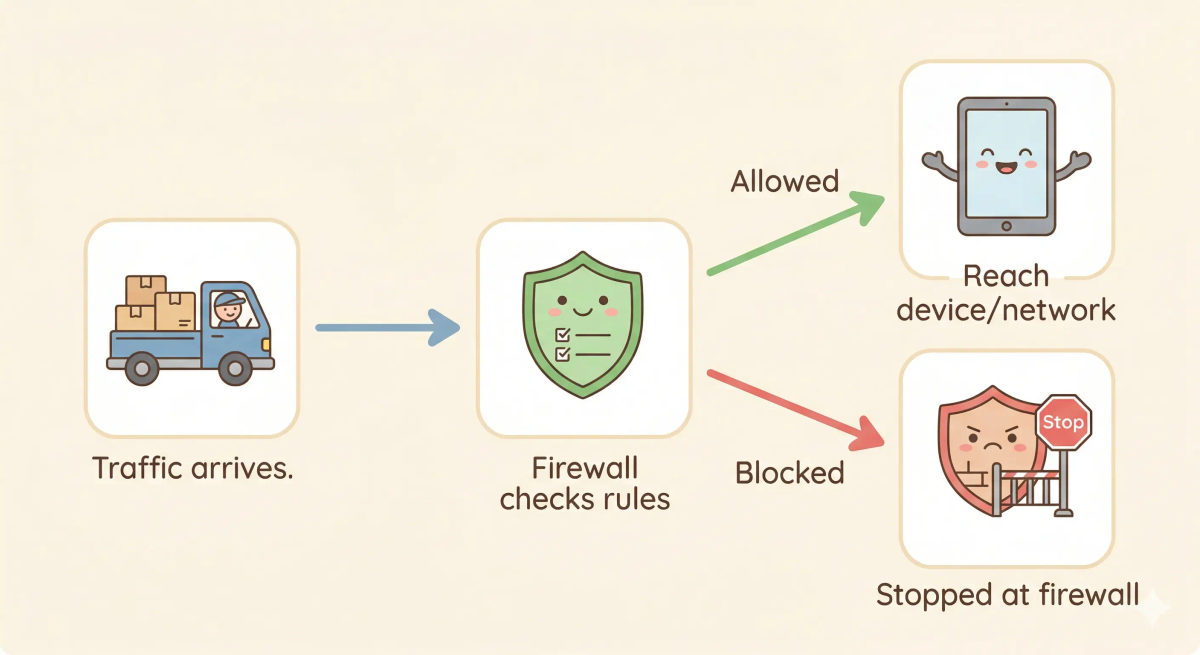
- Data tries to enter or leave a device or network.
- The firewall inspects that traffic using rules.
- It checks things like IP address, port number, protocol, or connection behavior.
- It allows approved traffic and blocks traffic that looks unsafe or unwanted.
👉 That means a firewall helps control which network connections are trusted.
Real-World Example
Example: Opening a website at work
Imagine you are at an office and you open a website in your browser.
Your computer sends a request out to the internet, and information starts coming back.
At that moment, the firewall helps decide whether that kind of traffic should be allowed. If it matches the expected rules, the traffic passes through and the website loads.
If the traffic comes from a blocked source or uses a blocked service, the firewall can stop it before it reaches the computer or internal network.
That is why many schools and offices can allow some websites or apps while blocking others.
What It Is Not
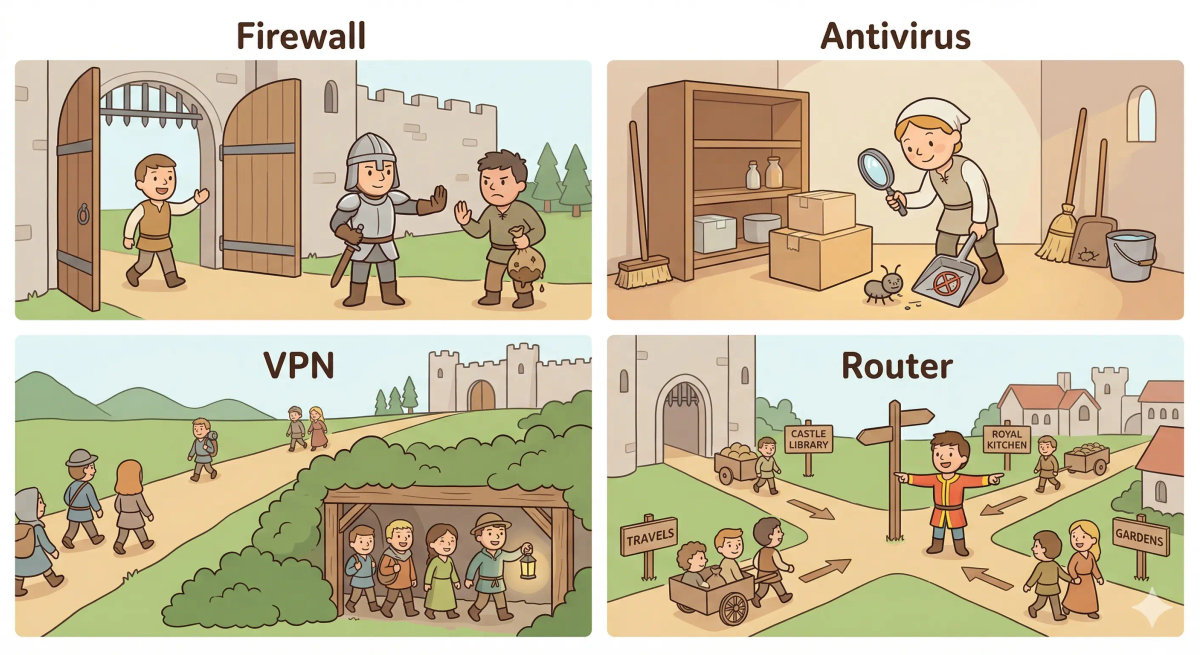
A firewall is not the same as…
- Antivirus — Antivirus looks for harmful software on a device, while a firewall controls network traffic.
- VPN — A VPN hides or protects traffic as it travels, while a firewall decides what traffic is allowed.
- Router — A router directs traffic between networks, while a firewall filters traffic based on rules.
- Password — A password proves who you are, while a firewall controls which connections can happen.
So while these ideas are related, a firewall specifically does the job of checking network traffic and enforcing access rules.
Why It Matters
- It helps block unwanted traffic.
- It reduces the chance of some attacks reaching devices.
- It gives companies control over what can access their systems.
- It helps keep networks safer and more organized.
This matters because a firewall helps create a safer doorway between your systems and the outside world.
Remember: the next time you connect to a website, app, or office network, picture a guard quietly checking the gate before traffic gets through.
A Slightly Deeper Version
A slightly deeper way to think about a firewall is that it enforces security rules on network traffic.
Some firewalls only look at basic connection details like source, destination, port, and protocol. More advanced firewalls can inspect traffic more deeply, track connection state, and apply smarter security policies.
So at a deeper level, a firewall is not just “block or allow.” It is a rule-based traffic control system for networks.
Common Questions
What does a firewall do in simple words?
A firewall checks network traffic and decides what should be allowed or blocked. In simple words, it works like a guard at a gate, letting trusted visitors in and stopping risky ones.
Does a firewall protect against viruses?
A firewall can help block suspicious network traffic, but it does not remove viruses from your device. Antivirus software is used to find and remove malicious software that is already on a device.
Is a firewall the same as antivirus?
No. A firewall controls what traffic can enter or leave a network, while antivirus software looks for harmful files, programs, or malware on a device.
Do I need a firewall at home?
Yes, most home users should have a firewall. Your Wi-Fi router usually has a built-in firewall, and your computer or phone may also have firewall protection.
What happens if I turn off my firewall?
If you turn off your firewall, your device or network may become easier to reach from unwanted or risky traffic. Some apps may work differently, but your overall protection is usually weaker.
Can a firewall block websites?
Yes. A firewall can block websites, apps, services, ports, or types of traffic based on its rules. Schools, offices, routers, and companies often use firewalls this way.
Does a firewall stop hackers?
A firewall can reduce the risk of unwanted access by blocking suspicious traffic, but it cannot stop every hacker or every type of cyberattack by itself.
What is the difference between a hardware firewall and a software firewall?
A hardware firewall is usually built into a router or separate security device and protects a network. A software firewall runs on a computer or device and protects that specific device.
Is the firewall on my router enough?
For many home users, a router firewall is a useful first layer of protection. But devices can still benefit from software firewalls, antivirus tools, updates, and safe browsing habits.
Why would a firewall block an app?
A firewall may block an app if the app tries to use a network connection that is not allowed by the firewall rules. This can happen with games, video calls, file sharing apps, or unknown programs.
In Short
- A firewall is like a guard at a gate
- Its job is to check traffic entering or leaving a system
- It helps block unwanted or unsafe connections
- It is different from antivirus, VPN, and routers
- It matters because it adds an important layer of network protection