 Internet vs Wi-Fi Explained Simply for Beginners
 If you have ever said “the Wi-Fi is down” when the real problem might be something else, this page will help you build a clear mental model.
The Internet is like the giant city-wide road system that connects the world.
Wi-Fi is like the short wireless footbridge that connects your device to your local home station.
So the main difference is simple:
- The internet is the bigger global network that connects devices and services around the world.
- Wi-Fi is one local way for your device to connect to your router without a cable.
If you only remember one thing, remember this: Wi-Fi helps you reach your local network; the internet is the wider world beyond it.
Quick Comparison Table
| Feature | Internet | Wi-Fi |
|---|---|---|
| Main role | Global network of connected networks | Short-range wireless connection method |
| Simple analogy | The whole road system across the giant city | A small wireless bridge from your device to your local station |
| Scope | Very large, worldwide | Small, local area like a home, office, or café |
| Main purpose | Move data across the world | Connect devices to a router without cables |
| Works with | Websites, email, games, calls, apps, cloud services | Phones, laptops, tablets, TVs, smart devices |
| Can you have it without the other? | Yes, in some forms such as wired internet | Yes, you can have Wi-Fi even without working internet |
| Best use | Reaching online services | Connecting your device to the nearby network |
Story Hook
Imagine a giant connected city.
The city has roads, bridges, tunnels, rail lines, and routes that connect one neighborhood to another and one district to the next.
Now imagine you are inside your home in one neighborhood of that city. You still need a quick, easy way for your phone or laptop to get from your couch to the little neighborhood station that links your home to the rest of the city.
Those are two different jobs.
One job is the big connection system across the whole city. The other job is the small local wireless link from your device to your nearby station.
That is the easiest way to start understanding internet vs Wi-Fi.
Main Analogy
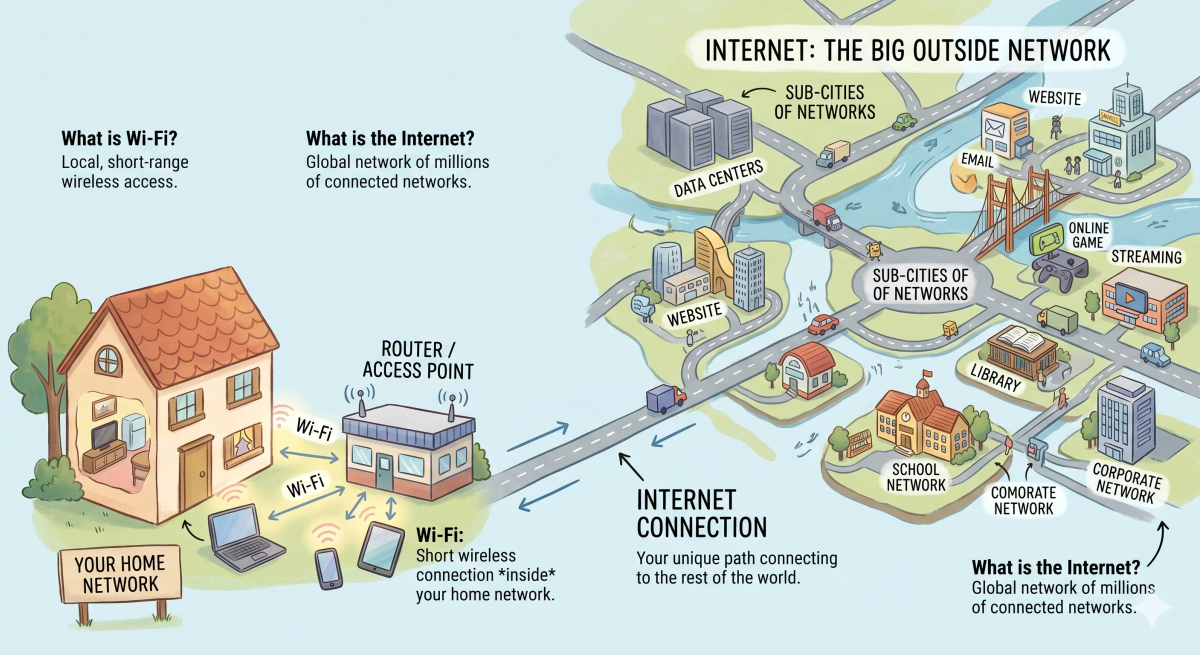
Think of the internet and Wi-Fi like a giant connected city
- City-wide roads, bridges, and routes = the internet
- Your home neighborhood = your local network
- Neighborhood station = your router/access point
- Phone, laptop, and tablet = your devices
- Short wireless footbridge = Wi-Fi
- Faraway libraries, shops, and offices = online services and servers
So the easiest way to understand this comparison is:
- Internet = the big worldwide connection system
- Wi-Fi = the short local wireless link that helps your device join that system through your router
What Problem Does Each One Solve?
Internet
In the city story, the internet solves the “how can the whole city stay connected?” problem.
Roads, tunnels, and routes let people and deliveries move between neighborhoods and distant places.
In the real world, the internet connects devices, servers, and networks across the globe so data can travel from one place to another.
Wi-Fi
In the city story, Wi-Fi solves the “how does my device reach the neighborhood station without using a cable road?” problem.
Your phone or laptop does not want to be tied down with a wire every time it needs to connect.
In the real world, Wi-Fi lets your device connect wirelessly to a nearby router or access point.
The actual difference
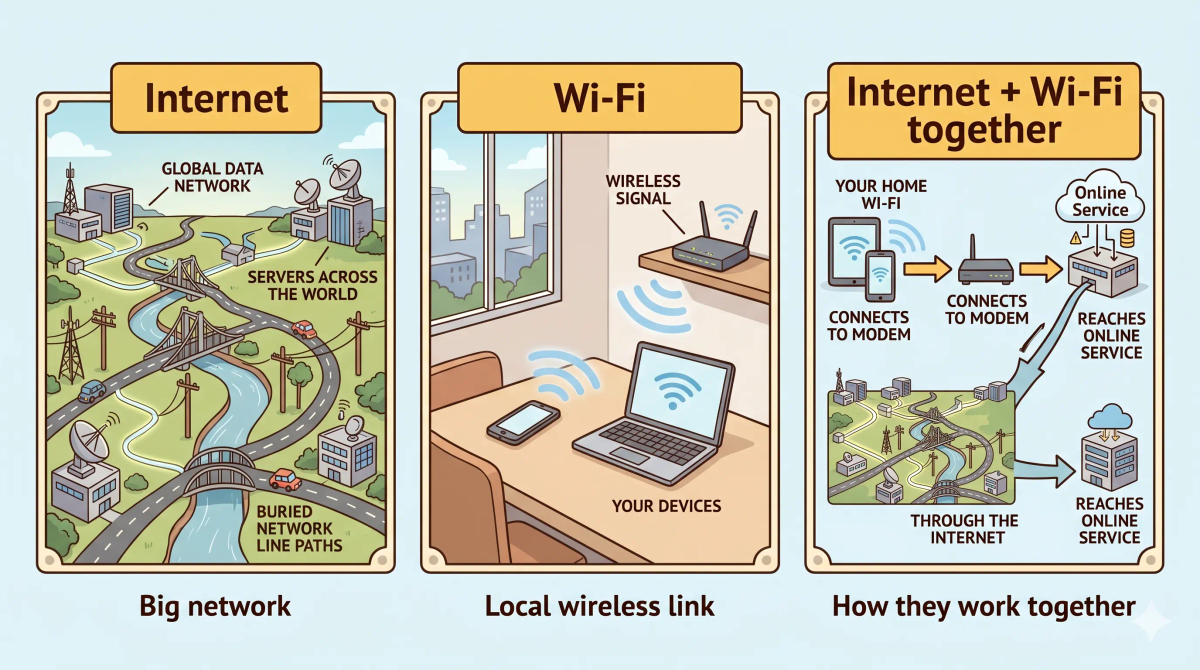
In the story world, the internet is the giant city connection system, while Wi-Fi is the short wireless bridge between your device and your neighborhood station.
In the real world, that means the internet is the larger global network, while Wi-Fi is a local wireless technology used to connect devices to a router.
So the actual difference is that the internet is the destination network you want to reach, whereas Wi-Fi is one way of reaching your local network.
How the Difference Works in the Story
Internet in the story
- The city has routes connecting many neighborhoods and distant places.
- Deliveries can travel across roads, tunnels, and bridges.
- The route system helps things move from one part of the city to another.
- Many services use the same city-wide paths.
Wi-Fi in the story
- A person at home wants to send a message from their couch.
- Instead of plugging into a wire road, they step onto a short wireless footbridge.
- That footbridge takes them to the neighborhood station.
- The neighborhood station then sends the message onward into the bigger city.
How the Difference Works in the Real World
Internet in the real world
- Networks around the world connect through infrastructure such as cables, routers, wireless links, and exchange points.
- Data travels across this larger global system.
- Many services use the internet, including the web, email, messaging, games, and video streaming.
- The internet is the broader foundation underneath online communication.
Wi-Fi in the real world
- Your router or access point creates a local wireless network.
- Your device connects to that local wireless signal.
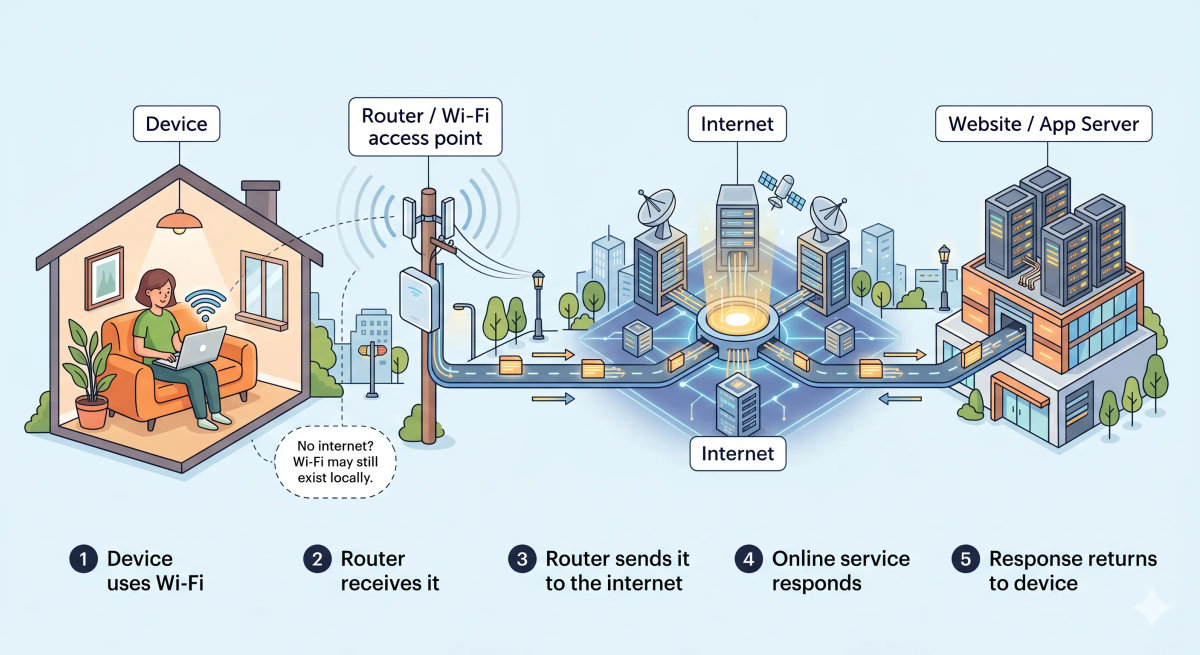
- Your device sends data to the router through Wi-Fi.
- The router then sends that data onward, possibly to the internet if internet access is available.
👉 That means Wi-Fi usually gets you to the router, not directly to the whole internet by itself.
Real-World Example
Example: Watching a video on your phone
When you watch a video on your phone at home, your phone usually uses Wi-Fi to talk to your router.
Your router then uses the internet to reach the video service.
If the Wi-Fi signal is weak, your phone may struggle to reach the router even if the internet connection itself is working. If the internet connection is down, your phone may still show that it is connected to Wi-Fi, but the video still will not load.
That is why the difference matters in practice.
The Difference Mapped Clearly
Internet
- The larger worldwide network
- Connects many networks and services together
- Carries web traffic, email, game data, video calls, and more
- Exists beyond your home
Wi-Fi
- A local wireless connection method
- Connects your device to a nearby router or access point
- Usually works only within a limited area
- Is not the same thing as the wider internet
Mental shortcut: internet = the big outside network, Wi-Fi = the short wireless link to your local router.
What Internet and Wi-Fi Are Not
This comparison is not the same as…
- Router — a router is the device that often provides Wi-Fi and connects your local network onward.
- Ethernet — Ethernet is a wired way to connect to a network.
- Web — the web is one service that runs on the internet.
- Mobile data — mobile data is another way to reach the internet, usually through a cellular network instead of Wi-Fi.
So while these ideas are related, the unique job of this comparison is understanding the difference between the larger global network and the local wireless connection method.
Why the Difference Matters
- It helps you troubleshoot better.
- It helps you know whether the problem is local or external.
- It makes networking terms less confusing.
- It helps you understand how your home setup works.
This matters because internet and Wi-Fi are often used as if they are the same thing, and understanding the difference helps you figure out what is actually happening when you connect.
A memorable closer: the next time something “online” stops working, remember Wi-Fi is the short link to your router, while the internet is the bigger world beyond it.
A Slightly Deeper Version
A slightly deeper way to think about this comparison is that the internet is a global system of interconnected networks that route data between endpoints, while Wi-Fi is a wireless local-area networking technology that lets nearby devices connect to an access point or router.
They seem similar because many people use Wi-Fi as their normal path to the internet, but the real distinction is that Wi-Fi is a local access method, while the internet is the broader network being accessed.
Common Questions
Is the internet the same as Wi-Fi?
No. Wi-Fi is a local wireless way to connect a device to a nearby router, while the internet is the bigger outside network.
Which is better: internet or Wi-Fi?
They do different jobs, so one is not “better.” Wi-Fi is a connection method; the internet is the wider network.
Do I need Wi-Fi to use the internet?
No. You can also use Ethernet or mobile data to reach the internet.
When should I use internet instead of Wi-Fi?
You do not really choose between them in that way. More accurately, you choose how to connect to the internet, such as via Wi-Fi, Ethernet, or mobile data.
Why do people confuse internet and Wi-Fi?
Because in daily life people often reach the internet through Wi-Fi, so the two ideas get blurred together.
In Short
- The internet is like the giant road system of the connected city
- Wi-Fi is like the short wireless footbridge to your neighborhood station
- The main difference is that internet is the big network, while Wi-Fi is one local way to connect to it
- Use internet when talking about the wider online world
- Use Wi-Fi when talking about your nearby wireless connection