 How the Internet Works: Explained Simply for Beginners
 Imagine you want to send a birthday card to a friend who lives far away.
You write the card, put it in an envelope, add the address, and drop it into the delivery system. A little later, it reaches the right house.
When you open a website, send a message, or watch a video, something very similar happens.
You tap once, and a moment later the right page, picture, or video appears on your screen. But what happens in between?
That hidden journey is exactly how the internet works.
The internet works by breaking information into small pieces, sending those pieces across connected networks to the right destination, and then sending the response back to your device.
Main Analogy
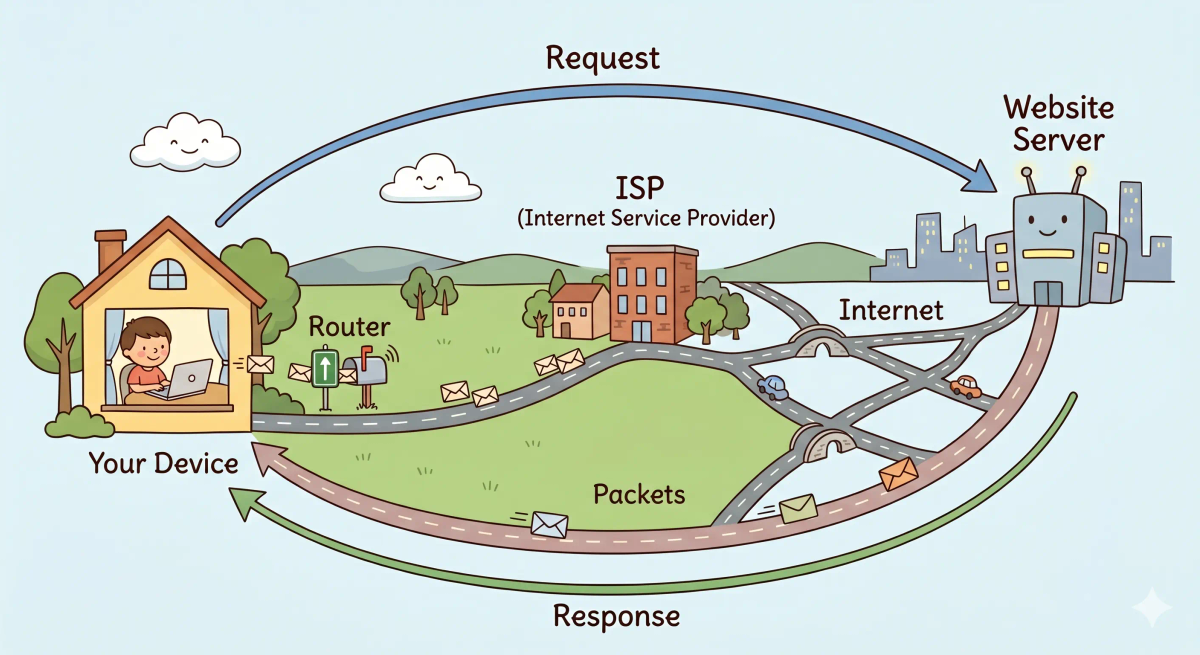
Think of how the internet works like a giant delivery road system
- Your phone or laptop = your house sending or receiving mail
- Data packets = tiny envelopes carrying pieces of information
- Routers and networks = roads, intersections, and sorting centers
- The internet = the full delivery system connecting places together
So the easiest way to understand how the internet works is to imagine millions of little envelopes traveling across a huge road network to reach the right building and then return with the answer.
Meet the Key Players
Before we follow the journey, let’s meet the important parts:
- Your device — the place where the request begins
- Router — the nearby traffic guide that sends your data in the right direction
- ISP — the company that connects your home to the wider internet
- Servers — powerful computers that store websites, videos, apps, and data
- Packets — small pieces of information that travel across the network
These are the main characters in the story of how the internet works.
What Problem Does This Process Solve?
If there were no giant delivery road system, your little envelope would never know how to leave your neighborhood, where to go next, or how to reach the right building.
In the real world, that means your phone or laptop would not be able to reach websites, apps, or online services that live on other computers around the world.
So the internet works the way it does because it needs to connect distant devices and move information between them quickly and reliably.
Before the Process Begins
The process begins when you do something simple, like typing a website name, tapping a video, sending a message, or opening an app.
In the story world, that is like writing a card, putting a destination on it, and handing it to the delivery system.
That small starting moment sets the whole journey in motion.
How It Works in the Story
- You decide to send a message from your house.
- The message is split into many tiny envelopes so it is easier to carry.
- The envelopes are handed to the nearest traffic guide and local delivery road.
- They move through intersections and sorting points across the wider road system.
- The envelopes reach the correct building in another town or city.
- That building sends back its own envelopes with the answer.
- The return envelopes travel back through the road system to your house.
- You open them and see the full result.
How It Works in the Real World
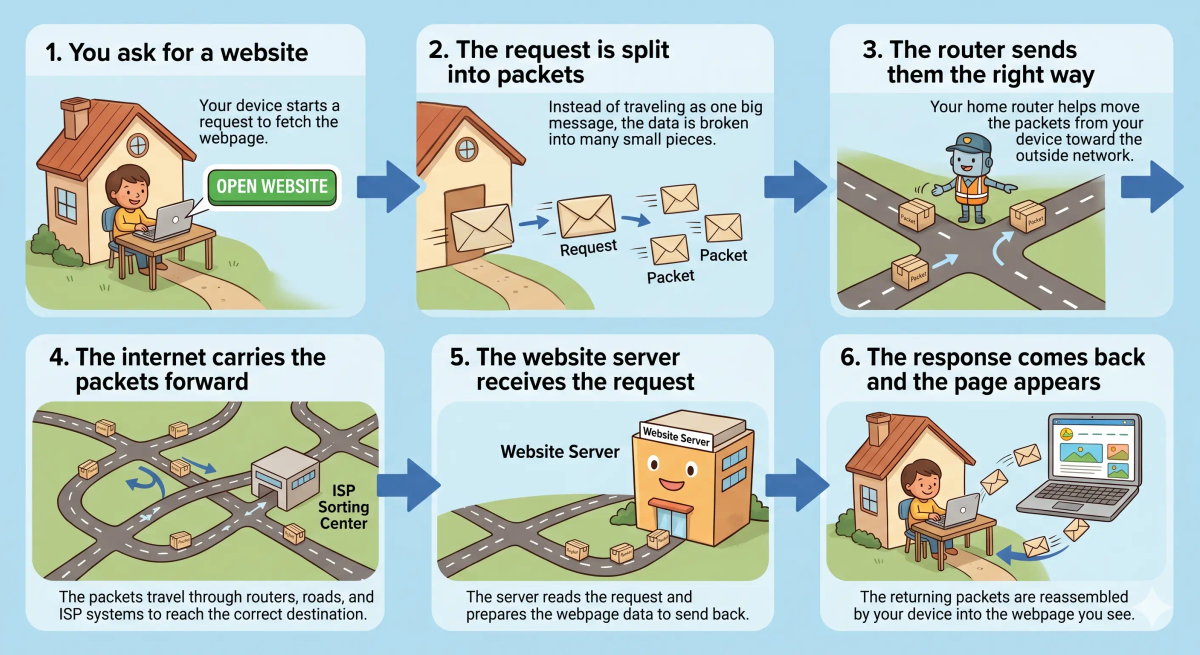
- You open a website, app, or online service on your device.
- Your device creates a request and breaks the data into small packets.
- Those packets are sent first to your router and then to your internet service provider.
- From there, the packets travel across many connected networks on the internet.
- The packets reach the server that holds the website, video, or service you asked for.
- The server sends back response packets containing the data you need.
- Your device receives those packets and puts them back together.
- Your browser or app shows the final result on your screen.
👉 That means the internet takes a request from your device to a distant server and back again through a series of small, fast steps.
Real-World Example
Example: Opening a website
When you type a website name and press Enter, your device begins the journey right away.
First, it prepares a request. Then the request is sent out through your router and into the wider internet. It travels across connected networks until it reaches the website’s server. The server sends the website data back, and your browser displays the page.
All of this usually happens so quickly that it feels instant.
Where the Process Can Slow Down or Go Wrong
Sometimes the process is not instant.
In the story world, that could happen if roads are crowded, a sorting center is overloaded, a delivery route is broken, or the destination building is slow to answer.
In the real world, delays or errors can happen when your connection is weak, networks are congested, a server is overloaded, or some part of the route is temporarily unavailable.
That is why the internet can sometimes feel slow, broken, or confusing.
What It Is Not
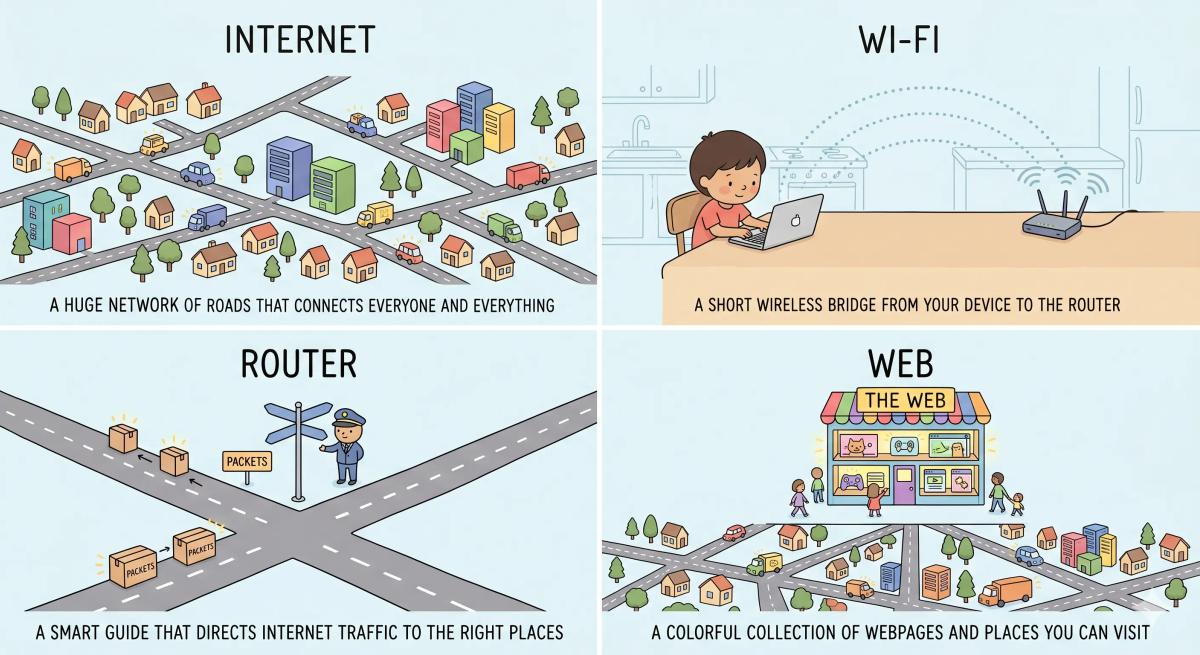
The internet is not the same as…
- Wi-Fi — Wi-Fi is just one way your device connects to a local network
- The web — the web is a service that runs on top of the internet
- A Router — a router helps direct traffic, but it is only one part of the system
- A Server — a server is one destination on the internet, not the whole internet
So while these are related, the internet specifically explains the connected network system that moves data between devices and services.
Why This Process Matters
- It lets devices talk to each other across the world
- It makes websites, apps, videos, and messages possible
- It moves information quickly in both directions
- It connects people, businesses, schools, and services
This matters because the internet quietly helps billions of devices exchange information every day.
The next time you open a website or send a message, remember that this whole invisible delivery journey is what helps make it possible.
A Slightly Deeper Version
A slightly deeper way to understand how the internet works is that it uses a group of networking rules and systems to move packets from one device to another across many separate networks.
Your data is split into packets, each packet is given destination information, routers forward those packets along paths through the network, and the receiving device reassembles them into usable information.
That is how large things like webpages, messages, and videos can travel so quickly across the world.
Common Questions
What starts the internet working?
The process starts when your device sends a request, such as opening a website, loading an app, or sending a message.
Does the internet send everything as one big file?
No. It usually breaks information into smaller packets so the data is easier to send, route, and reassemble.
Is the internet the same as Wi-Fi?
No. Wi-Fi is just the local wireless link between your device and a nearby network. The internet is the much bigger network beyond that.
Why can the internet sometimes be slow?
It can slow down because of weak signals, crowded networks, busy servers, or problems somewhere along the route.
In Short
- The internet works like a giant delivery road system
- It starts when your device sends a request
- That request is broken into packets and routed across networks
- A server sends the answer back the same way
- It matters because this is what makes websites, apps, messages, and videos possible