 Internet vs Web Explained Simply for Beginners
 If you have ever used “internet” and “web” as if they mean the same thing, this page will help you separate them clearly.
The Internet is like the whole city road system connecting places together.
The web is like the collection of shops, libraries, and pages you visit using those roads.
So the main difference is simple:
- The internet is the global network that connects computers and devices.
- The web is one major service that runs on top of the internet.
If you only remember one thing, remember this: the web uses the internet, but the web is not the whole internet.
Quick Comparison Table
| Feature | Internet | Web |
|---|---|---|
| Full role | Global network of connected devices | System of websites and web pages |
| Simple analogy | Roads, bridges, tunnels, and delivery routes | Shops, libraries, and pages people visit |
| Main purpose | Connect devices and move data | Let people access linked documents, sites, and apps |
| Uses | Web, email, games, video calls, file transfer, messaging | Websites, blogs, web apps, search results, online articles |
| Accessed through | Many apps and protocols | Usually a browser |
| Depends on | Physical networks, routers, cables, wireless links, protocols | Internet connection, browsers, URLs, HTTP/HTTPS, servers |
| Best mental shortcut | The connection system | One service on that system |
Story Hook
Imagine a giant city.
The city has roads, bridges, tunnels, traffic signals, delivery routes, and addresses. Because of that road system, people can move from one place to another.
Inside the city, there are many places you can visit: libraries, shops, cinemas, schools, offices, and restaurants.
Now imagine someone says, “The city road system and the library are the same thing.”
That would feel wrong. The library uses the roads, but the roads are much bigger than the library.
That is the easiest way to start understanding internet vs web.
Main Analogy
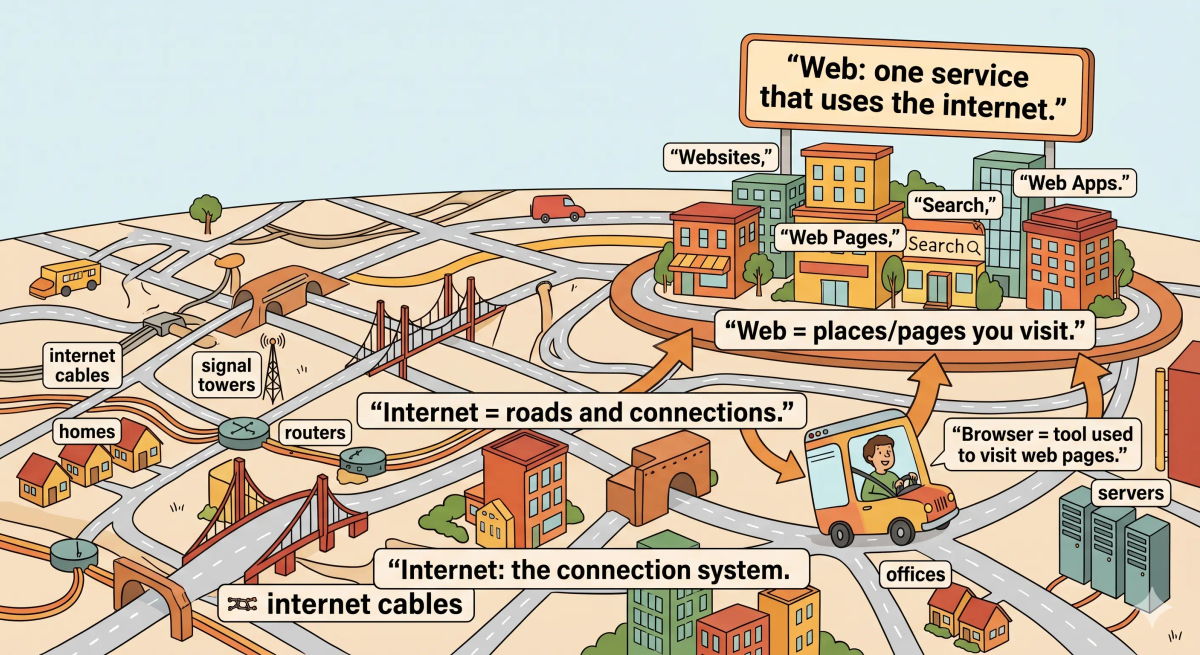
Think of the internet and the web like a giant connected city
- City roads and routes = the internet
- Buildings you can visit = online services
- Libraries, shops, and information boards = the web
- Street addresses = IP addresses and domain names
- Delivery rules = internet and web protocols
- Browser = the vehicle or visitor tool you use to visit web places
So the easiest way to understand this comparison is:
- Internet = the full connection system
- Web = websites and pages that travel across that connection system
What Problem Does Each One Solve?
Internet
In the city story, the internet solves the “how can places connect to each other?” problem.
Without the road system, buildings would exist, but people and deliveries could not easily move between them.
In the real world, the internet connects computers, phones, servers, routers, and networks so data can travel from one place to another.
Web
In the city story, the web solves the “how can people visit useful pages and places?” problem.
The road system alone does not tell you which library shelf to open or which shop display to view. The web provides a way to publish, link, request, and view pages.
In the real world, the web is the system of websites and web pages that you usually access through a browser using URLs and HTTP/HTTPS.
The actual difference
In the story world, the internet is the road system connecting the whole city, while the web is a collection of buildings and pages people visit using those roads.
In the real world, that means the internet moves data between devices, while the web is one service for accessing websites, pages, and web apps.
So the actual difference is that the internet is the underlying network, whereas the web is something that runs on top of that network.
How the Difference Works in the Story
Internet in the story
- Roads connect homes, libraries, shops, and offices.
- Addresses help deliveries know where to go.
- Intersections and signs guide movement across the city.
- Many different activities can use the same roads.
- The road system keeps the city connected.
Web in the story
- A visitor wants to read something in a library building.
- The visitor uses the roads to reach that building.
- Inside the building, the visitor opens a specific page or shelf.
- Links act like signs that point to other pages and buildings.
- The visitor moves from page to page using the same road system underneath.
How the Difference Works in the Real World
Internet in the real world
- Devices and networks connect using cables, wireless links, routers, and other infrastructure.
- Data is split into packets and sent across many connected networks.
- Addresses and routing help data reach the correct destination.
- Many services can use this same global network.
Web in the real world
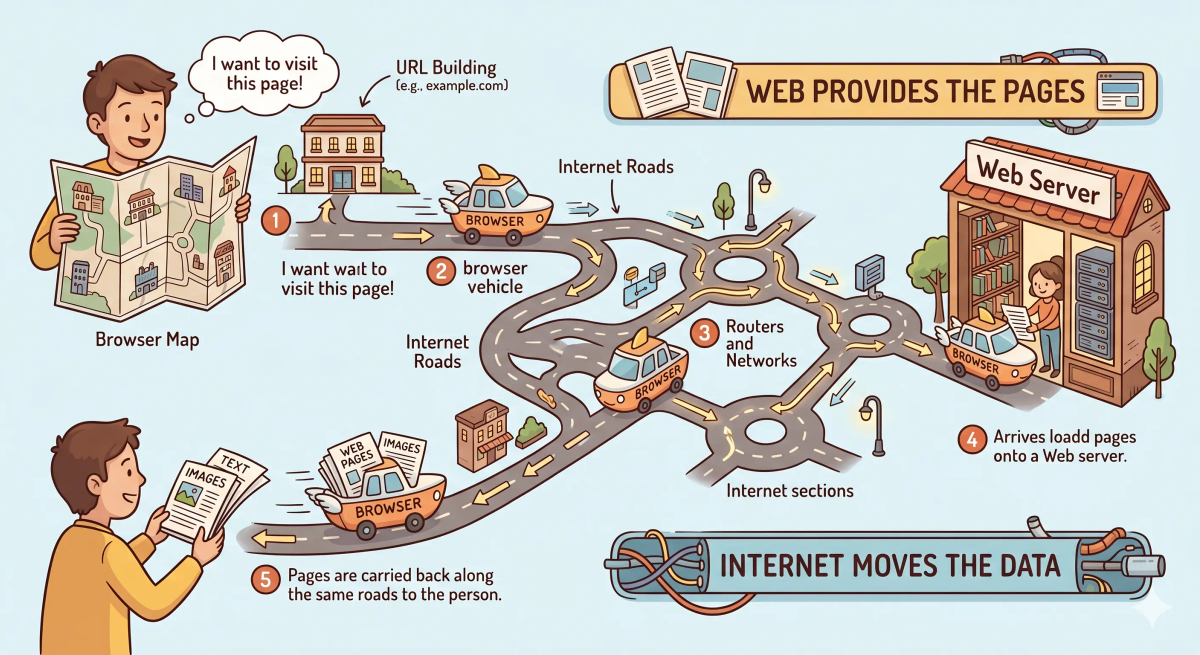
- You open a browser and type a URL or click a link.
- The browser uses web rules such as HTTP or HTTPS to request a page.
- The request travels across the internet to a web server.
- The server sends web content back, such as HTML, CSS, JavaScript, images, or data.
- Your browser turns that response into the page you see.
👉 That means the web is a passenger on the internet, not the entire vehicle.
Real-World Example
Example: Opening a website in your browser
When you type a website address into your browser, you are using the web.
The page request, however, has to travel across the internet.
Your browser asks for a web page. The request moves through the internet to a web server. The server sends the page back through the internet. Your browser displays it as a website.
That is why the difference matters in practice: the web is what you are visiting, and the internet is what carries you there.
The Difference Mapped Clearly
Internet
- Connects devices and networks around the world
- Carries many kinds of data, not just web pages
- Supports services like email, video calls, online games, file transfers, and websites
- Works like the foundation underneath many online activities
Web
- Is made of websites, web pages, links, and web apps
- Usually accessed through browsers like Chrome, Safari, Firefox, or Edge
- Uses web technologies such as URLs, HTTP/HTTPS, HTML, CSS, and JavaScript
- Depends on the internet to move requests and responses
Mental shortcut: Internet = roads, web = places and pages you visit on those roads.
What Internet and Web Are Not
This comparison is not the same as…
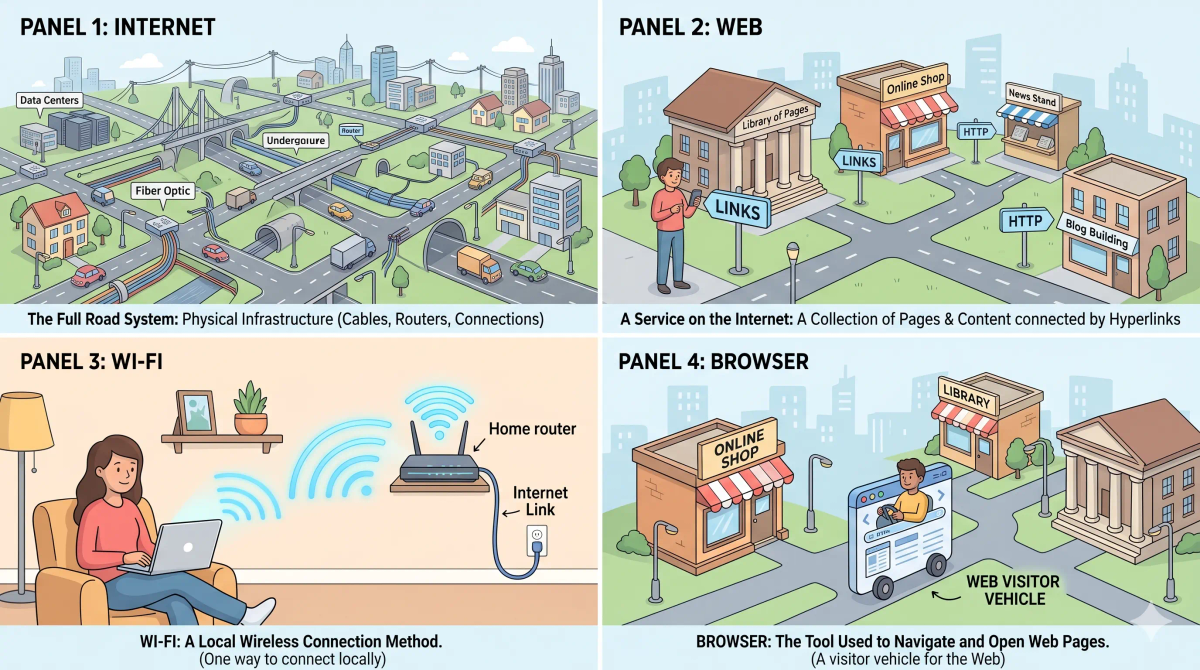
- Wi-Fi — Wi-Fi is one way your device connects to a local network; it is not the whole internet.
- Browser — a browser is a tool for visiting the web; it is not the web itself.
- Website — a website is one place on the web; it is not the entire web.
- Server — a server hosts content or services; it is one destination on the internet, not the full network.
So while these ideas may be related, the unique job of this comparison is understanding the difference between the network itself and one major service running on it.
Why the Difference Matters
- It helps you understand what is actually broken when something online fails.
- It helps you explain why email, games, and video calls are not exactly the same as the web.
- It helps you understand why a browser needs an internet connection to load websites.
- It gives you a stronger mental model for learning DNS, HTTP, servers, routers, and web apps.
This matters because people often say “the internet” when they mean “a website” or “the web.” That is fine in everyday speech, but the distinction becomes useful when you are learning how technology actually works.
The next time someone says “the internet is down,” remember to ask: is the road system broken, or is one building on the web not opening?
A Slightly Deeper Version
A slightly deeper way to think about this comparison is that the internet is a global network of networks that moves data using agreed-upon addressing and routing systems.
The web, or World Wide Web, is an information system built on top of that network. It uses URLs to identify resources, HTTP/HTTPS to request them, and browsers to display them.
They may seem similar because most people experience the internet through websites. But the real distinction is simple: the internet is the infrastructure; the web is one application layer experience built on it.
Common Questions
Is the internet the same as the web?
No. The internet is the global connection network. The web is the system of websites and pages that uses that network.
Which is bigger: the internet or the web?
The internet is bigger. The web is only one major service that runs on top of the internet.
Do I need the internet to use the web?
For normal websites, yes. Your browser needs an internet connection to request and load web pages from web servers.
Can the internet work without the web?
Yes. Other internet services can still exist without the web, such as email, file transfer, messaging systems, online games, and video calls.
Why do people confuse the internet and the web?
People confuse them because the web is the most visible way many users experience the internet. When they open a browser, search, and visit pages, it feels like “using the internet.”
In Short
- The internet is like the full city road system.
- The web is like the libraries, shops, and pages you visit using those roads.
- The main difference is that the internet connects devices, while the web provides websites and pages.
- Use internet when talking about the underlying network.
- Use web when talking about websites, web pages, links, and browser-based content.