 What Is Bandwidth? Explained Simply for Beginners
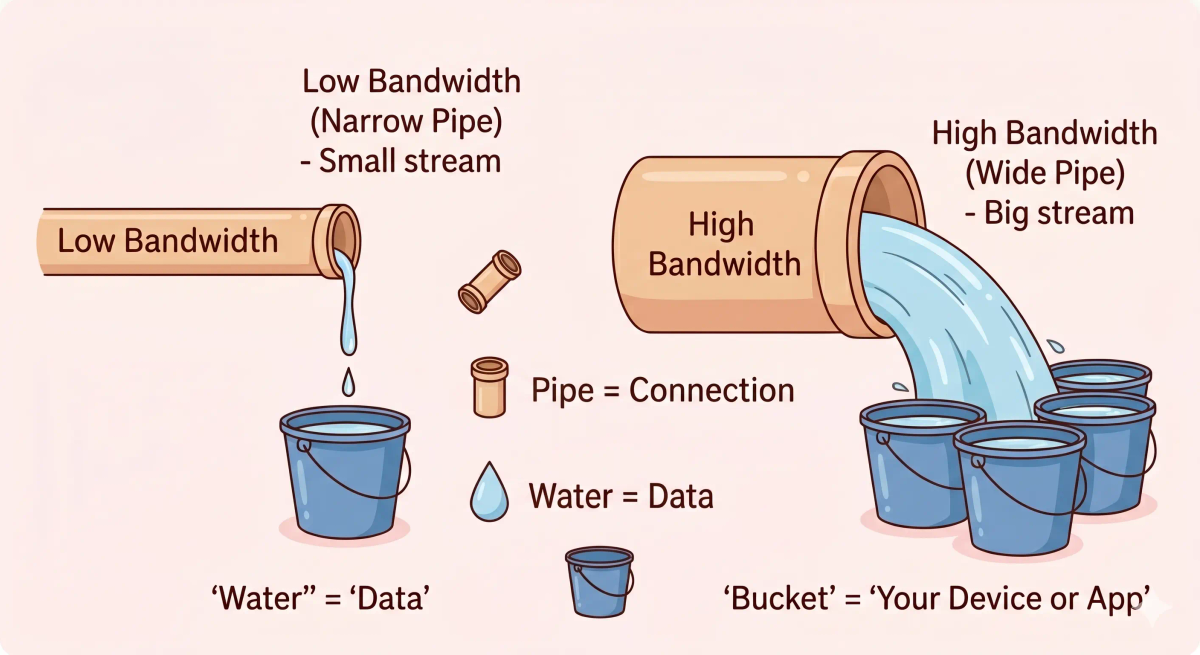
 Imagine you have a water pipe filling buckets.
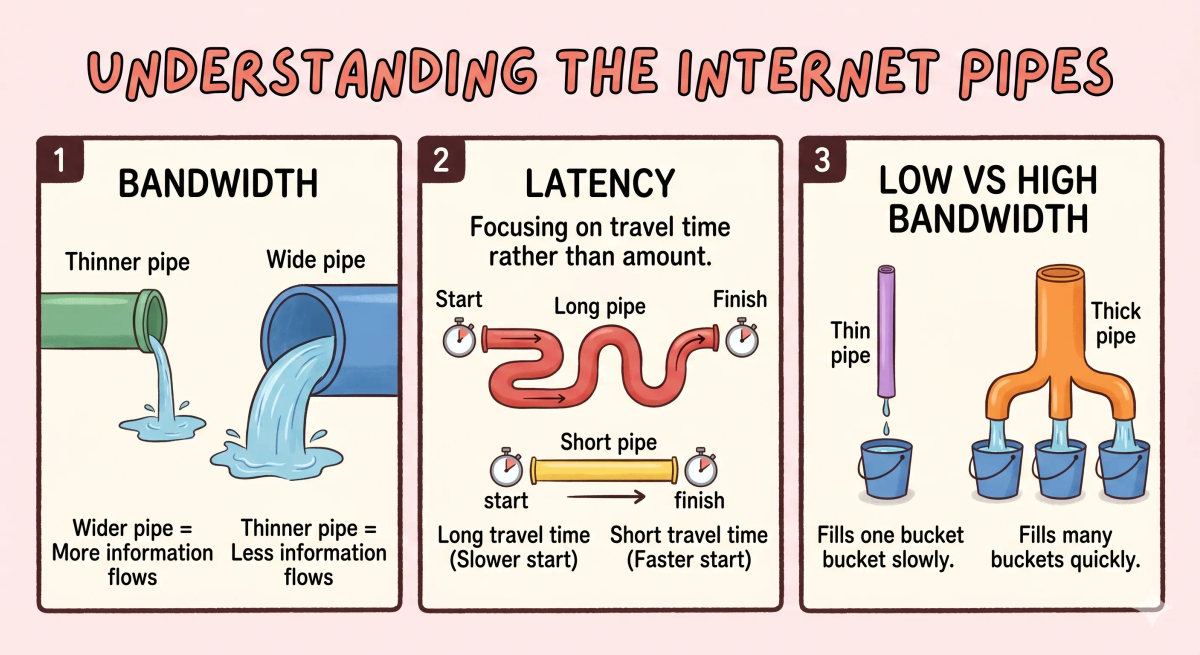
If the pipe is thin, only a small amount of water can flow through at one time.
If the pipe is wide, much more water can flow through at once.
The important question here is not how far the water travels.
The important question is: how much can flow through at one time?
That is the easiest way to start understanding bandwidth.
Bandwidth is the amount of data that can be transferred over a connection in a certain amount of time.
Main Analogy
Think of bandwidth like the width of a water pipe
- Data = water flowing through the pipe
- Network connection = the pipe
- More bandwidth = a wider pipe that can carry more water at once
- Less bandwidth = a narrower pipe that can carry less water at once
- Using the internet = filling buckets with water
So the easiest way to understand bandwidth is to think of it as the carrying capacity of the connection.
What Problem Does It Solve?
If a pipe is too narrow, only a little water can flow at once.
That can be a problem if many buckets need to be filled, or if one very large bucket needs a lot of water quickly.
In the real world, the same idea applies to data. If a connection has low bandwidth, it can only carry a smaller amount of data at a time.
So the job of bandwidth as a concept is to describe the carrying capacity of a connection.
How It Works in the Story
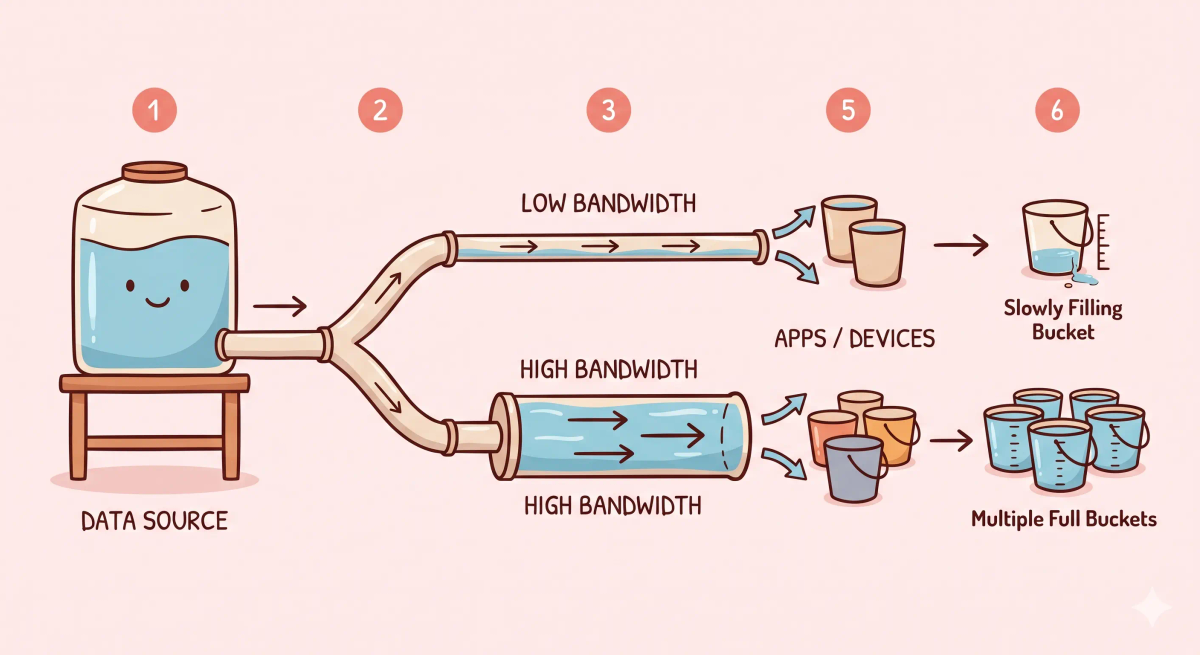
- Water begins flowing through a pipe.
- The width of the pipe limits how much water can move at once.
- A narrow pipe allows only a little water through.
- A wide pipe allows much more water through.
- The more water that can flow, the faster large buckets can be filled.
How It Works in the Real World
- Data needs to travel across a network connection.
- The connection has a certain carrying capacity.
- Low bandwidth means less data can move in a given time.
- High bandwidth means more data can move in the same time.
- That affects how quickly large downloads or multiple streams can be handled.
👉 That means bandwidth is mainly about capacity, not delay.
Real-World Example
Example: Streaming videos on many devices
When several people in a home are streaming videos, playing games, and downloading files at the same time, the connection needs to carry a lot of data.
At that moment, bandwidth matters because it affects how much total data the connection can handle.
If everything matches the expected behavior, enough bandwidth lets several devices work smoothly at the same time.
If not, videos may buffer and downloads may take longer because too much is trying to fit through a connection with limited capacity.
What It Is Not
Bandwidth is not the same as…
- Latency — latency is how long data takes to travel, while bandwidth is how much data can move
- Internet speed in general — people often say “speed,” but bandwidth specifically means carrying capacity
- Storage size — storage is how much data you can keep, while bandwidth is how much you can move
- Signal strength — signal strength affects connection quality, while bandwidth describes transfer capacity
So while these ideas are related, bandwidth specifically does capacity measurement.
Why It Matters
- It affects how much data your connection can handle at once
- It matters for downloads, streaming, and homes with many devices
- It helps explain why multiple activities can slow each other down
- It is a key part of internet performance
This matters because bandwidth helps determine how much online activity your connection can support at one time.
The next time many people are using the internet together, remember that they are all sharing the same data “pipe.”
A Slightly Deeper Version
A slightly deeper way to think about bandwidth is that it represents the maximum data transfer capacity of a connection, usually measured over time.
It is often described using units like Mbps or Gbps. A connection with more bandwidth can carry more data in the same time period, even though that does not automatically mean lower latency.
That is why bandwidth is especially important for large transfers and many simultaneous activities.
Common Questions
What is bandwidth in simple words?
Bandwidth is the amount of data a connection can carry at once. In simple words, it is like the width of a water pipe: a wider pipe can let more water flow through at the same time.
Is bandwidth the same as internet speed?
Not exactly. People often use “internet speed” to mean bandwidth, but bandwidth is specifically about how much data can move at once. Speed can also feel affected by latency, congestion, Wi-Fi quality, and server distance.
Is more bandwidth better?
Usually yes. More bandwidth means your connection can carry more data at the same time, which helps when many devices or data-heavy apps are being used.
Is bandwidth the same as latency?
No. Bandwidth is about capacity, while latency is about delay. Bandwidth asks, “How much data can fit?” Latency asks, “How long does the trip take?”
Why does bandwidth matter for streaming?
Streaming needs a steady flow of data. Higher-quality video, such as HD or 4K, usually needs more bandwidth so the video can play smoothly without buffering.
What uses a lot of bandwidth?
Video streaming, large downloads, cloud backups, online games, video calls, software updates, and file sharing can all use bandwidth, especially when several devices are active at once.
Can one person or device use up the bandwidth?
Yes. One person downloading large files, streaming high-quality video, or running cloud backups can use a big part of the available bandwidth and slow things down for others.
How can I increase bandwidth?
You can increase available bandwidth by upgrading your internet plan, using a better router, switching to Ethernet, reducing heavy background downloads, or limiting how many devices use the connection at once.
In Short
- Bandwidth is like the width of a water pipe
- Its job is to describe how much data can flow through a connection
- It helps explain overall capacity
- It is different from latency, storage, and signal strength
- It matters because it affects how much online activity a connection can handle