 What Is Jitter? Explained Simply for Beginners
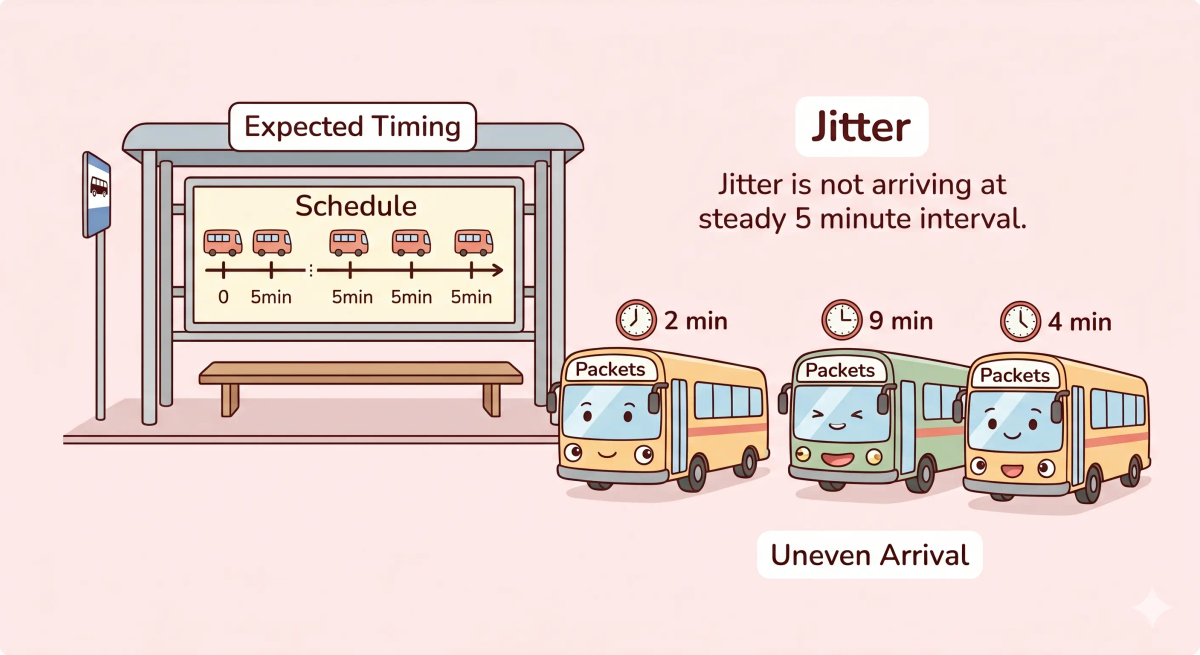
 Imagine you are waiting for a line of buses that are supposed to arrive every 5 minutes.
If the buses arrive exactly on time — 5 minutes, 5 minutes, 5 minutes — the system feels smooth and predictable.
But what if one bus arrives in 2 minutes, the next in 9 minutes, and the next in 4?
Even if the average wait does not look terrible, the ride still feels uneven and annoying because the timing keeps changing.
That is the easiest way to start understanding jitter.
Jitter is the variation in delay between packets or messages as they travel across a network.
Main Analogy
Think of jitter like buses arriving at uneven times
- Packets or network messages = buses coming down the route
- Expected smooth timing = buses arriving at a steady rhythm
- Jitter = the arrival times bouncing around unevenly
- Network path = the bus route
- Voice or video app = the passengers depending on smooth arrivals
So the easiest way to understand jitter is to think of it as “unsteady timing” in how network messages arrive.
What Problem Does It Solve?
If buses do not arrive at predictable times, the ride feels messy even if the road is still working.
Passengers may bunch up, wait awkwardly, or miss smooth timing.
In the real world, apps like voice calls, video calls, and live games often need packets to arrive in a steady rhythm, not just eventually.
So the job of jitter as a concept is to describe how uneven the timing becomes from one packet to the next.
How It Works in the Story
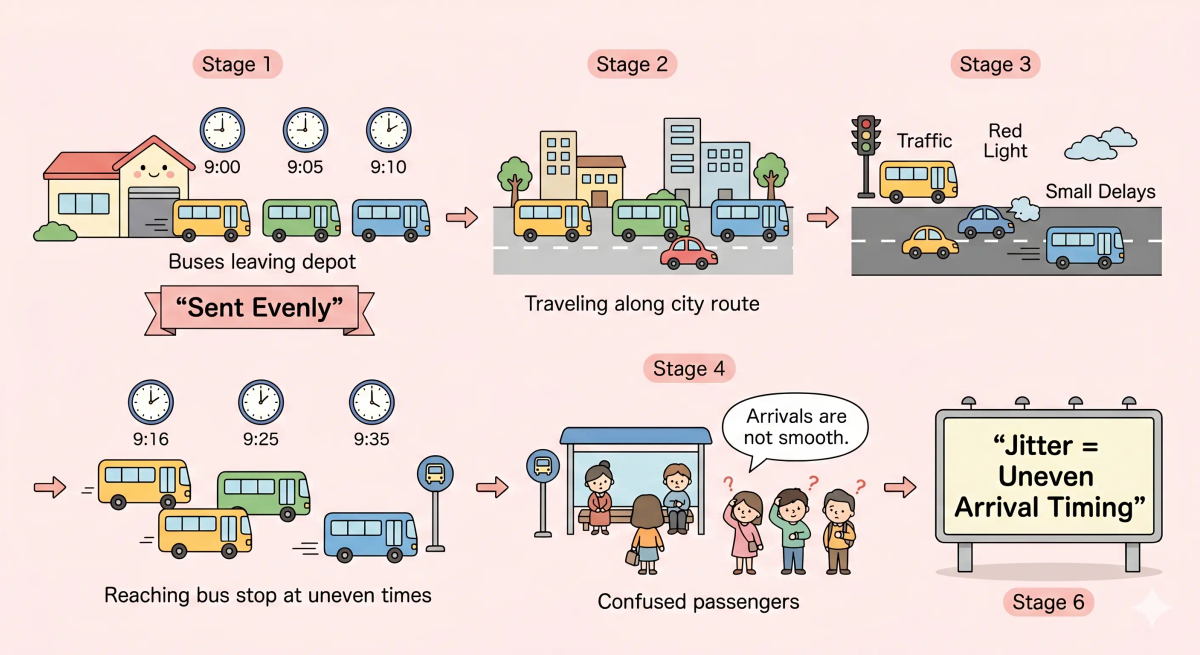
- A bus route is supposed to deliver buses at regular intervals.
- One bus comes early.
- The next bus comes late.
- The next one is different again.
- The arrival pattern becomes uneven.
- Passengers feel the ride is unstable and unpredictable.
How It Works in the Real World
- Packets are sent across the network one after another.
- Ideally, they arrive with fairly steady timing.
- But network conditions can make some packets arrive sooner and others later.
- That variation in arrival time is called jitter.
- Too much jitter can make real-time experiences feel choppy or awkward.
👉 That means jitter helps describe how uneven packet timing feels, not just how slow it is on average.
Real-World Example
Example: A voice call sounding choppy
When you are on a voice call, your device sends small pieces of audio again and again.
At that moment, jitter matters because those pieces need to arrive in a steady rhythm so the sound feels natural.
If everything matches the expected behavior, the call sounds smooth and clear.
If not, the timing may jump around and the audio can sound choppy, robotic, or uneven.
What It Is Not
Jitter is not the same as…
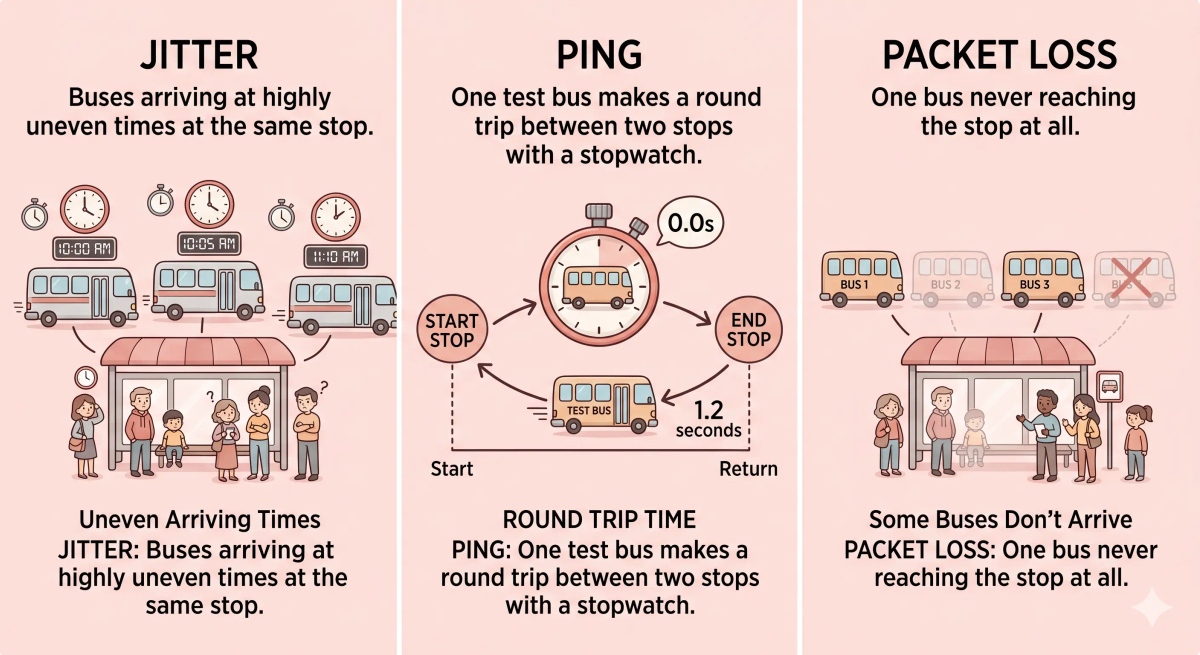
- Latency — latency is the overall delay, while jitter is the variation in timing from one packet to the next
- Ping — ping is a test of round-trip time, while jitter is about how inconsistent those timings can become
- Bandwidth — bandwidth is how much data can move, while jitter is about arrival consistency
- Packet loss — packet loss is when packets disappear entirely, while jitter is when they still arrive but not at steady times
So while these ideas are related, jitter specifically does timing variation measurement.
Why It Matters
- It affects voice calls, video calls, and live games
- It helps explain choppy or uneven real-time experiences
- It matters even when average speed looks fine
- It is a key part of smooth network performance
This matters because jitter is one of the reasons a connection can feel unstable even when it is not completely broken.
The next time a live call sounds awkward and uneven, remember that the issue may be timing variation, not just raw speed.
A Slightly Deeper Version
A slightly deeper way to think about jitter is that it measures how much packet delay varies over time.
A connection can have acceptable average delay but still perform badly for real-time traffic if the arrival times swing around too much. That is why low jitter is important for live communication and interactive apps.
Common Questions
What is jitter in simple words?
Jitter is the uneven timing of data packets arriving over a network. In simple words, it is like buses arriving at uneven times instead of coming in a steady rhythm.
Is low jitter good?
Yes. Low jitter is usually good because it means data packets arrive more steadily, which helps calls, games, and live video feel smoother.
Is jitter the same as Latency?
No. Latency is the overall delay, while jitter is how much that delay keeps changing. Latency asks, “How long does it take?” Jitter asks, “Is the timing steady?”
Is jitter the same as lag?
Not exactly. People often use “lag” to describe any delay or choppiness, but jitter specifically means packet timing changes from moment to moment.
Can I have low latency but still have jitter?
Yes. Your average delay may be low, but if packets arrive at uneven times, you can still have jitter that causes choppy calls, stutters, or unstable gameplay.
What causes jitter?
Jitter can be caused by busy networks, weak Wi-Fi, overloaded routers, long network routes, packet queuing, congestion, or unstable internet connections.
Why does jitter hurt voice and video calls?
Voice and video calls need packets to arrive in a steady rhythm. When jitter is high, audio can crackle, video can freeze, and conversations can feel choppy.
How can I reduce jitter?
You can reduce jitter by using Ethernet instead of Wi-Fi, moving closer to the router, closing heavy background apps, restarting network equipment, reducing network congestion, or choosing a more stable internet connection.
In Short
- Jitter is like buses arriving at uneven times
- Its job is to describe variation in packet timing
- It helps explain choppy live communication
- It is different from latency, ping, bandwidth, and packet loss
- It matters because smooth timing is important for real-time experiences