 What Is Latency? Explained Simply for Beginners
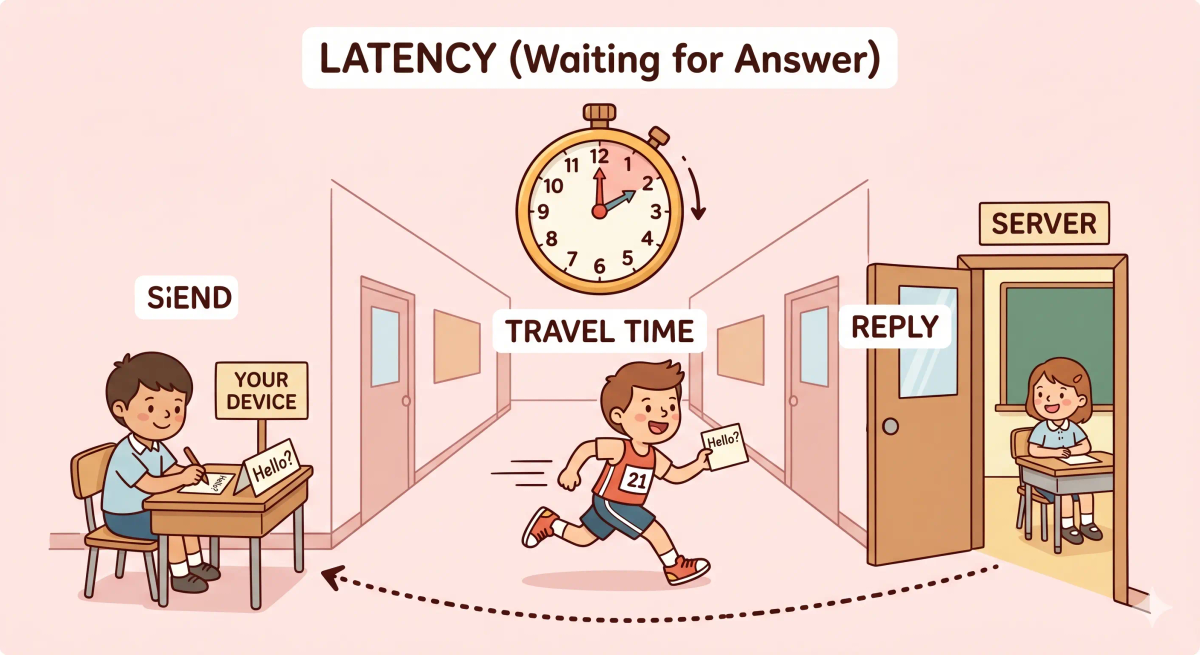
 Imagine you are in one classroom, and your friend is in another classroom down a long hallway.
You write a tiny note that says, “Are you ready?”
A runner grabs the note, runs down the hallway, gives it to your friend, waits for an answer, and runs back with the reply.
The key question is not how big the note is.
The key question is: how long did the trip take?
That is the easiest way to start understanding latency.
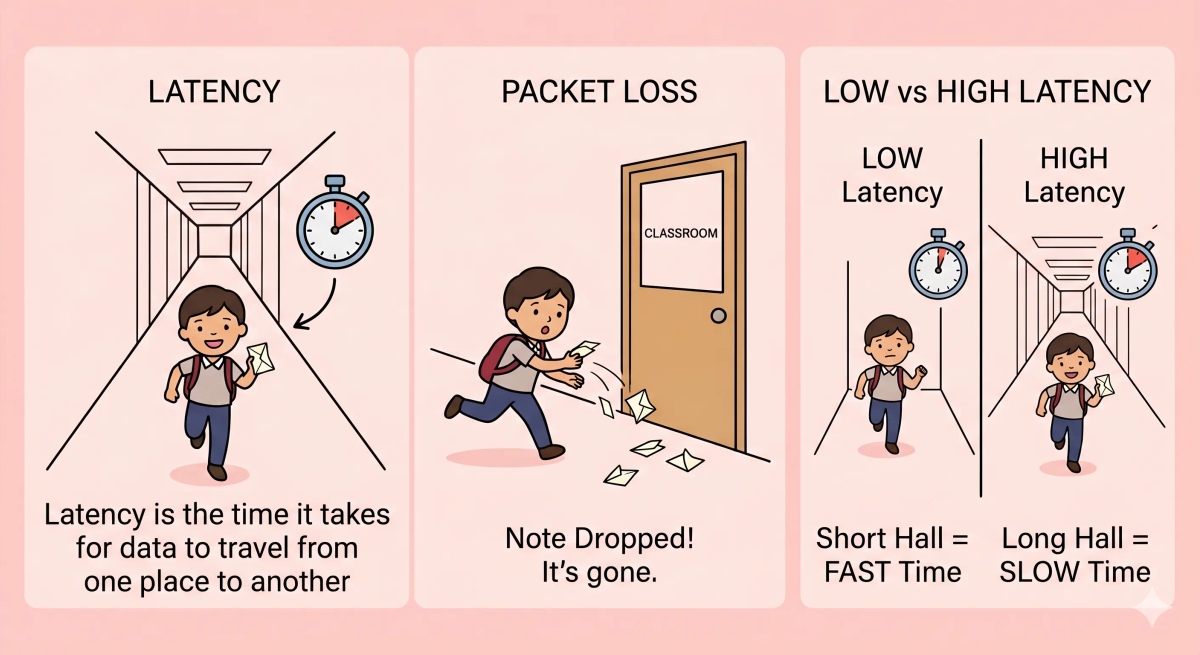
Latency is the time it takes for data to travel from one place to another, and often back again.
Main Analogy
Think of latency like a runner carrying a note down a hallway and back
- Your device = the student sending the note
- Server or other device = the friend receiving the note
- Data = the small written note
- Network path = the hallway
- Latency = how long the round trip takes
So the easiest way to understand latency is to think of it as the waiting time between sending a message and getting the answer back.
What Problem Does It Solve?
If you never thought about the travel time of the hallway runner, you might only focus on whether the note eventually arrived.
But for many activities, waiting matters a lot.
In the real world, even if data arrives successfully, it can still feel slow if the trip takes too long.
So the job of latency as a concept is to describe the delay between sending data and seeing the response.
How It Works in the Story
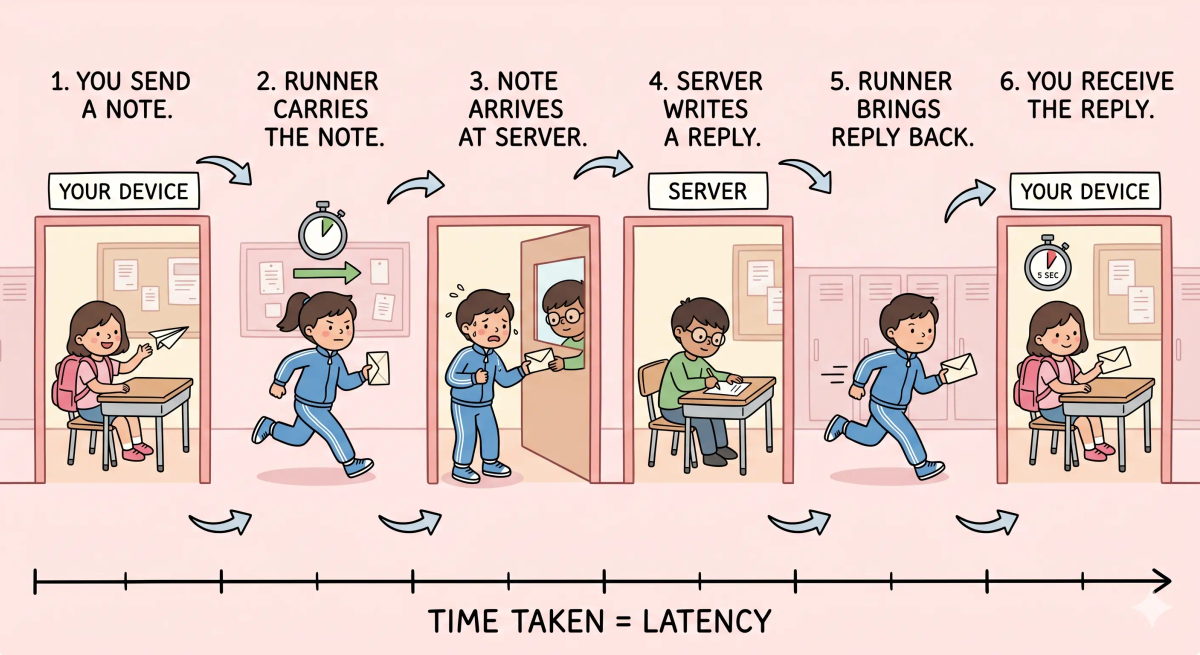
- You write a small note.
- The runner starts carrying it down the hallway.
- Your friend receives the note and writes a reply.
- The runner carries the reply back.
- You wait until the answer reaches you.
- The total wait time is the latency.
How It Works in the Real World
- Your device sends a request across the network.
- The request travels to another device or server.
- That device or server responds.
- The response travels back to your device.
- The total delay for that trip is the latency.
👉 That means latency is mainly about how quickly the response starts coming back.
Real-World Example
Example: Playing an online game
When you press a button in an online game, your action must travel to the game server and the result has to come back.
At that moment, latency affects how quickly the game feels responsive.
If everything matches the expected behavior, low latency makes the action feel fast and smooth.
If not, high latency can make the game feel delayed, laggy, or slow to react.
What It Is Not
Latency is not the same as…
- Bandwidth — bandwidth is how much data can move at once, while latency is how long the trip takes
- Speed test download rate — download speed measures amount per second, while latency measures delay
- Packet Loss — packet loss is when data goes missing, while latency is about waiting time
- A weak Wi-Fi signal — weak Wi-Fi can cause problems, but latency specifically means delay in communication
So while these ideas are related, latency specifically does delay measurement.
Why It Matters
- It affects how fast interactive things feel
- It matters a lot for gaming, video calls, and live apps
- It helps explain why something can feel slow even when speed is high
- It is a key part of overall network experience
This matters because latency is one of the biggest reasons the internet can feel smooth or sluggish.
The next time something feels laggy, remember that the problem may not be the amount of data — it may be the waiting time.
A Slightly Deeper Version
A slightly deeper way to think about latency is that it measures delay in network communication.
It is often described as the time a packet takes to travel from a client to a server and, in many common explanations, back again. Many things can affect it, including physical distance, routing, congestion, and processing delays.
That is why low latency is especially important for real-time interaction.
Common Questions
What is latency in simple words?
Latency is the delay before data gets a response. In simple words, it is like sending a runner down a hallway with a note and waiting for the runner to come back.
Is low latency good?
Yes. Low latency is usually good because it means the response comes back faster, making online actions feel quicker and more responsive.
Is latency the same as internet speed?
No. Internet speed usually means how much data your connection can carry, while latency means how long you wait for a response to begin.
What is the difference between latency and bandwidth?
Latency is about delay, while bandwidth is about capacity. Latency asks, “How long does the trip take?” Bandwidth asks, “How much data can fit on the road at once?”
Why does high latency feel like lag?
High latency feels like lag because there is a bigger delay between what you do and what you see happen. This is especially noticeable in games, video calls, and remote work tools.
Can I have high internet speed and still have high latency?
Yes. You can have a fast connection that moves a lot of data overall, but still have high latency if responses take a long time to start coming back.
Why is my latency high?
Latency can be high because the server is far away, the network is crowded, Wi-Fi is weak, your router is overloaded, or your data is taking a longer route than expected.
How can I reduce latency?
You can reduce latency by moving closer to the router, using Ethernet instead of Wi-Fi, closing heavy background apps, restarting network equipment, choosing closer servers, or using a better internet route.
In Short
- Latency is like a runner carrying a note down a hallway and back
- Its job is to describe how long the trip takes
- It helps explain delay in network communication
- It is different from bandwidth, packet loss, and download speed
- It matters because it affects how responsive the internet feels