 What Is Ping? Explained Simply for Beginners
 Imagine you are standing on one side of a mountain valley.
You shout, “Hello!”
A moment later, you hear the echo come back.
That little test tells you two useful things:
- the other side is reachable
- and you can feel how long the echo took to return
That is the easiest way to start understanding ping.
Ping is a simple network test that checks whether another device can be reached and how long a small round trip takes.
Main Analogy
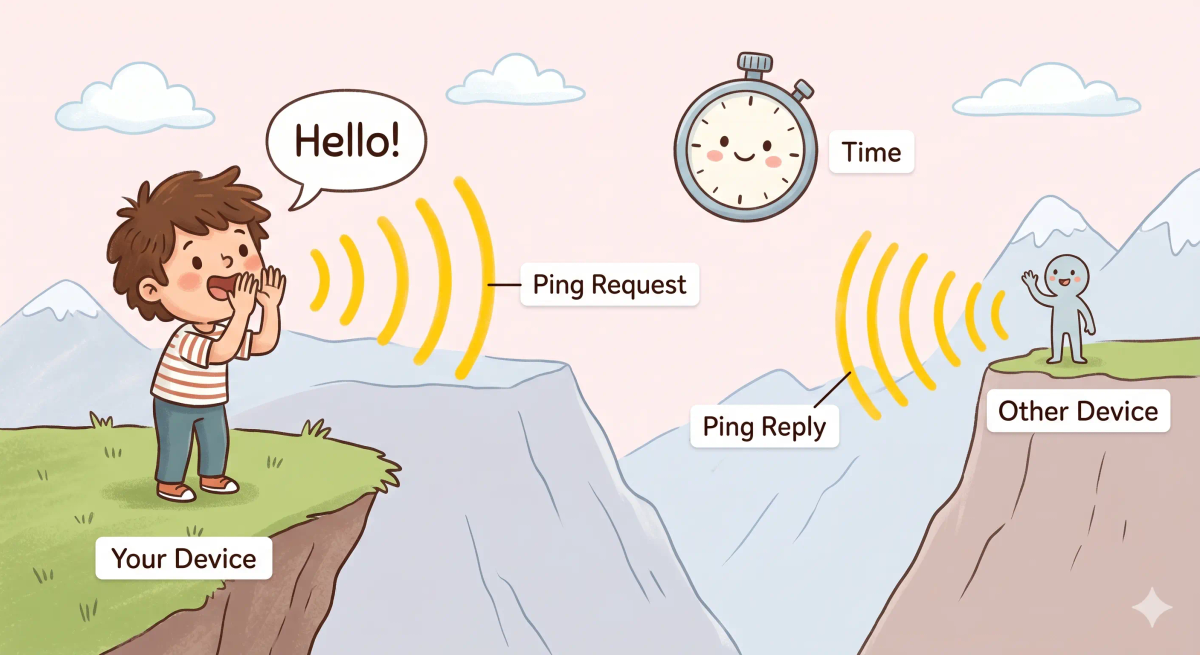
Think of ping like shouting into a valley and listening for the echo
- Your device = the person shouting
- Another device or server = the far valley wall answering back
- Ping request = the shout
- Ping reply = the echo
- Ping time = how long the echo takes to return
So the easiest way to understand ping is to think of it as a quick “Are you there?” test plus a timing check.
What Problem Does It Solve?
If you could never shout across the valley and hear anything back, you would not know whether the other side was reachable or whether the path between you was clear.
In the real world, computers also need a simple way to test whether another device is reachable and whether the round trip feels quick or slow.
So the job of ping is to do a small check: “Can I reach you, and how long does it take to hear back?”
How It Works in the Story
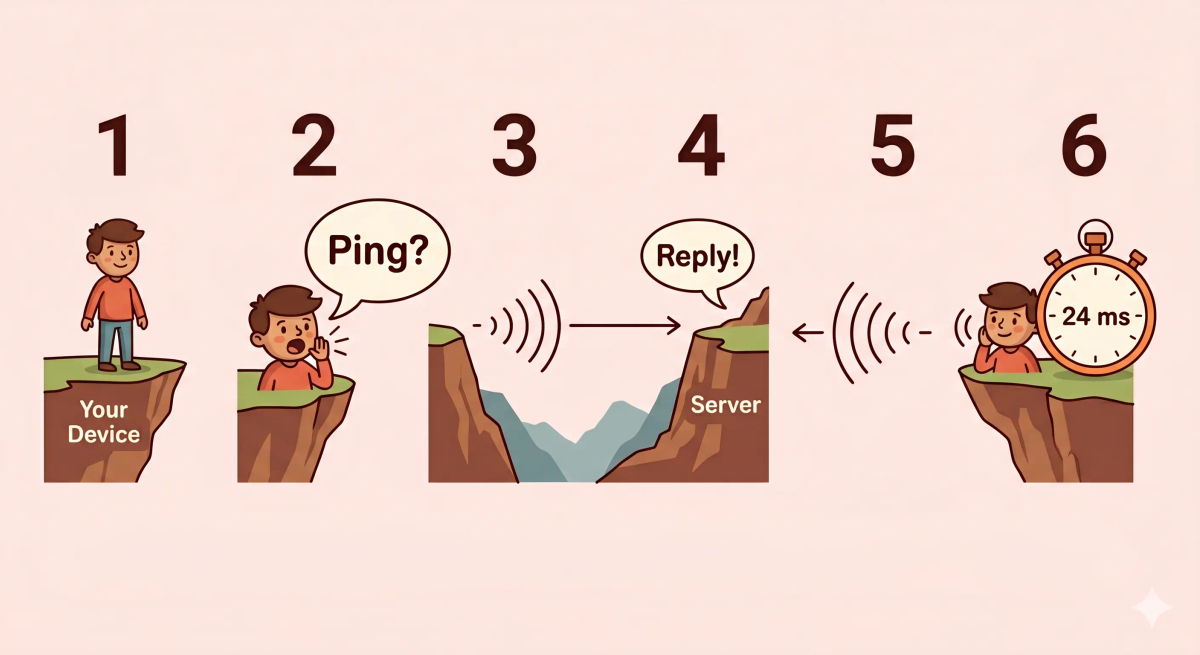
- You stand at the valley edge.
- You shout a short message.
- The sound wave travels across the valley.
- The far side sends an echo back.
- You listen for the reply.
- You measure how long the whole round trip took.
How It Works in the Real World
- Your device sends a tiny test message to another device.
- The message travels across the network.
- If the other device is reachable, it sends a reply back.
- Your device measures how long the round trip took.
- Repeating this test can help show whether the path is reachable and how responsive it feels.
👉 That means ping helps test reachability and round-trip delay.
Real-World Example
Example: Testing whether a website server is reachable
When your connection feels strange, you may want to know whether a server is reachable at all.
At that moment, ping can act like a quick test shout across the network.
If everything matches the expected behavior, you get replies back and can see the timing.
If not, the replies may be very slow or may not come back at all, which suggests a path or reachability problem.
What It Is Not
Ping is not the same as…
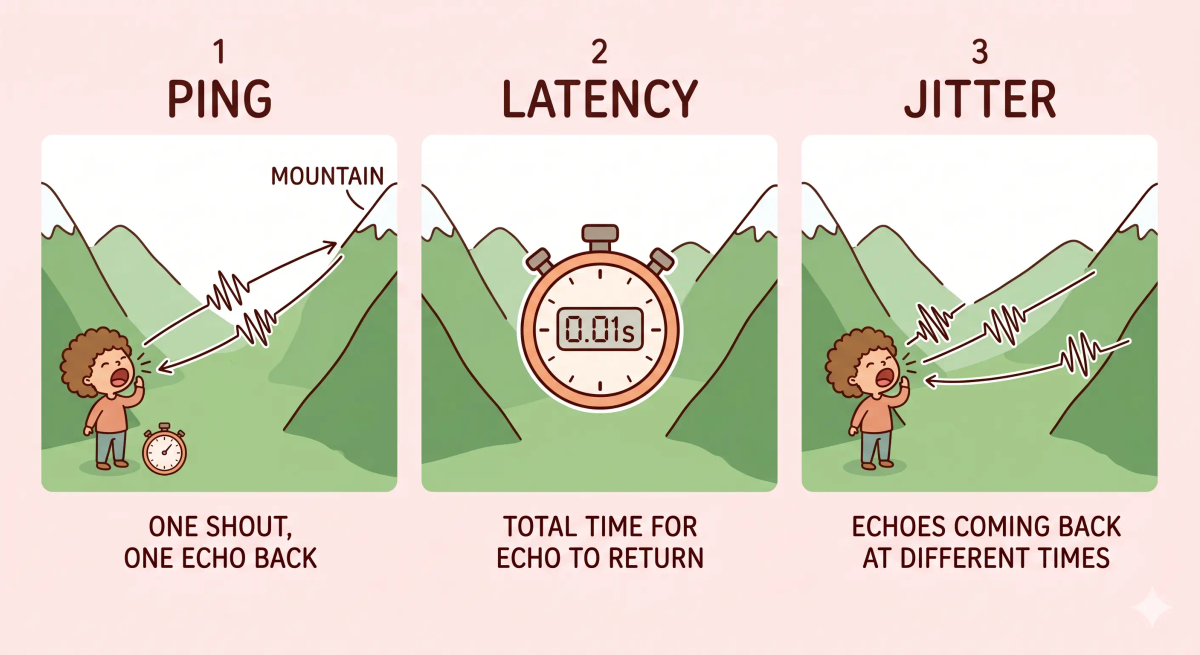
- Latency — latency is the general idea of delay, while ping is one specific test often used to measure a simple round trip
- Bandwidth — bandwidth is how much data can move, while ping measures timing for a tiny test message
- A download speed test — ping is a small reachability and timing check, not a large transfer test
- Jitter — jitter is variation in timing across repeated trips, while ping is one individual test result or a series of simple tests
So while these ideas are related, ping specifically does tiny round-trip network testing.
Why It Matters
- It helps check whether another device is reachable
- It gives a quick feeling for response time
- It is useful for diagnosing network problems
- It helps explain whether a path feels responsive or delayed
This matters because ping is one of the simplest and most familiar ways to check whether a network path is alive.
The next time someone says “Try pinging it,” remember that they are asking for a quick “Are you there?” test with timing.
A Slightly Deeper Version
A slightly deeper way to think about ping is that it is a network utility that sends a small test message and measures the round-trip time for the reply.
Repeated pings can show whether a device is reachable, whether the delay is low or high, and whether some replies are being lost. That is why ping is such a common first step in network troubleshooting.
Common Questions
What is ping in simple words?
Ping is a test that checks whether another device or server can be reached and how long the round trip takes. In simple words, it is like shouting into a valley and listening for the echo to come back.
What does ping measure?
Ping measures how long it takes for a small message to travel from your device to another device or server and come back. This round-trip time is usually measured in milliseconds.
Is a lower ping better?
Usually yes. A lower ping means the round trip is faster, so online actions can feel more responsive.
What is a good ping?
A good ping depends on what you are doing. For browsing, a higher ping may still feel fine, but for online gaming or video calls, lower ping usually feels smoother.
Does ping measure internet speed?
No. Ping measures delay, not total internet speed. Internet speed is more about how much data your connection can carry, while ping is about how quickly a small message returns.
Why is my ping high?
Ping can be high because the server is far away, the network is busy, Wi-Fi is weak, your router is overloaded, or your internet route is taking extra steps.
Can ping fail even if the internet still works?
Yes. Some devices, servers, or networks block or ignore ping requests even though websites, apps, and other internet services still work.
Why do gamers care about ping?
Gamers care about ping because it affects how quickly the game reacts to their actions. Lower ping can make movement, aiming, and real-time actions feel more responsive.
In Short
- Ping is like shouting into a valley and listening for the echo
- Its job is to check whether another device is reachable and how long the reply takes
- It helps test round-trip delay in a simple way
- It is different from bandwidth, jitter, and full speed tests
- It matters because it is a quick way to test network responsiveness