 IPv4 vs IPv6 Explained Simply for Beginners
 If both terms look like confusing number formats, this page will help you understand what they actually mean.
IPv4 is like an older city address system with a limited number of address plates.
IPv6 is like a newer city address system with a massive supply of longer, more flexible address plates.
So the main difference is simple:
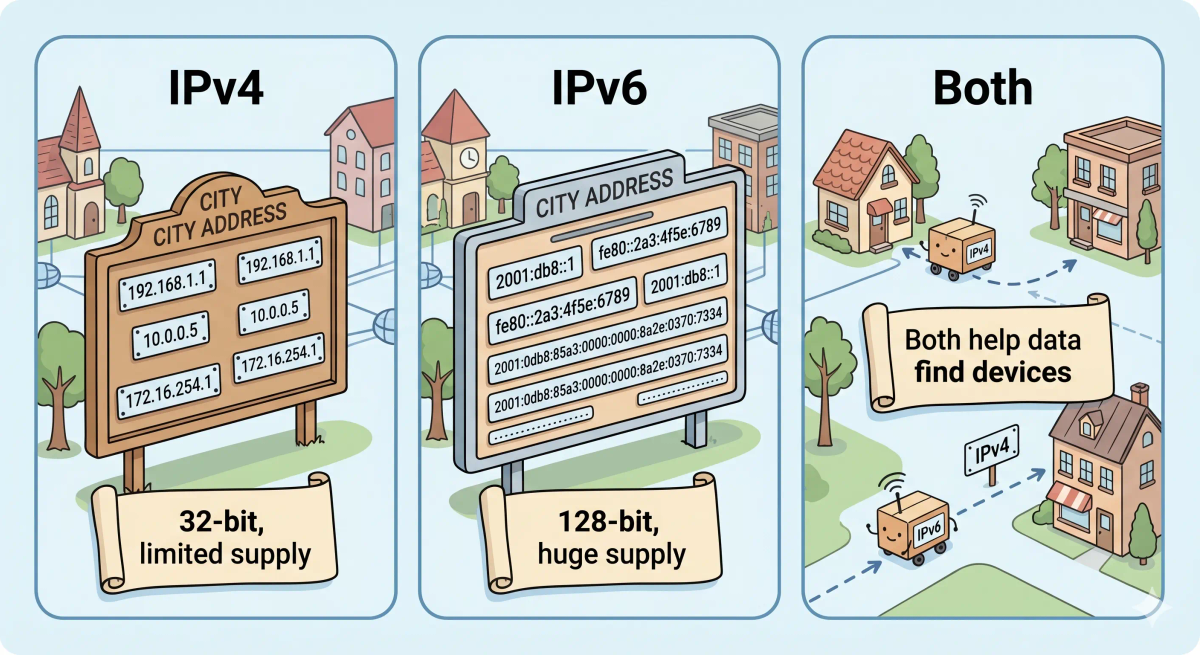
- IPv4 uses shorter 32-bit addresses, such as
192.168.1.1. - IPv6 uses longer 128-bit addresses, such as
2001:0db8:85a3::8a2e:0370:7334.
If you only remember one thing, remember this: IPv4 is the older, smaller address system; IPv6 is the newer, much larger address system.
Quick Comparison Table
| Feature | IPv4 | IPv6 |
|---|---|---|
| Full meaning | Internet Protocol version 4 | Internet Protocol version 6 |
| Simple analogy | Old city address plates | New expanded city address plates |
| Address size | 32-bit | 128-bit |
| Example | 192.168.1.1 | 2001:0db8:85a3::8a2e:0370:7334 |
| Format | Four numbers separated by dots | Groups of hexadecimal characters separated by colons |
| Address supply | Much smaller | Vastly larger |
| Main reason IPv6 exists | IPv4 addresses became limited | Provides many more unique addresses |
| Common today? | Still widely used | Increasingly used alongside IPv4 |
Story Hook
Imagine a giant city where every house, shop, school, and office needs its own address plate.
At first, the city is small. A simple address system works fine. There are enough address plates for everyone.
But over time, the city grows.
Suddenly there are apartments, new neighborhoods, delivery lockers, smart doors, tiny kiosks, floating homes, and thousands of new buildings. The old address system starts running out of unique address plates.
So the city creates a new address system.
The old system still exists because many places still use it. But the new system is designed for a much bigger future.
That is the easiest way to start understanding IPv4 vs IPv6.
Main Analogy
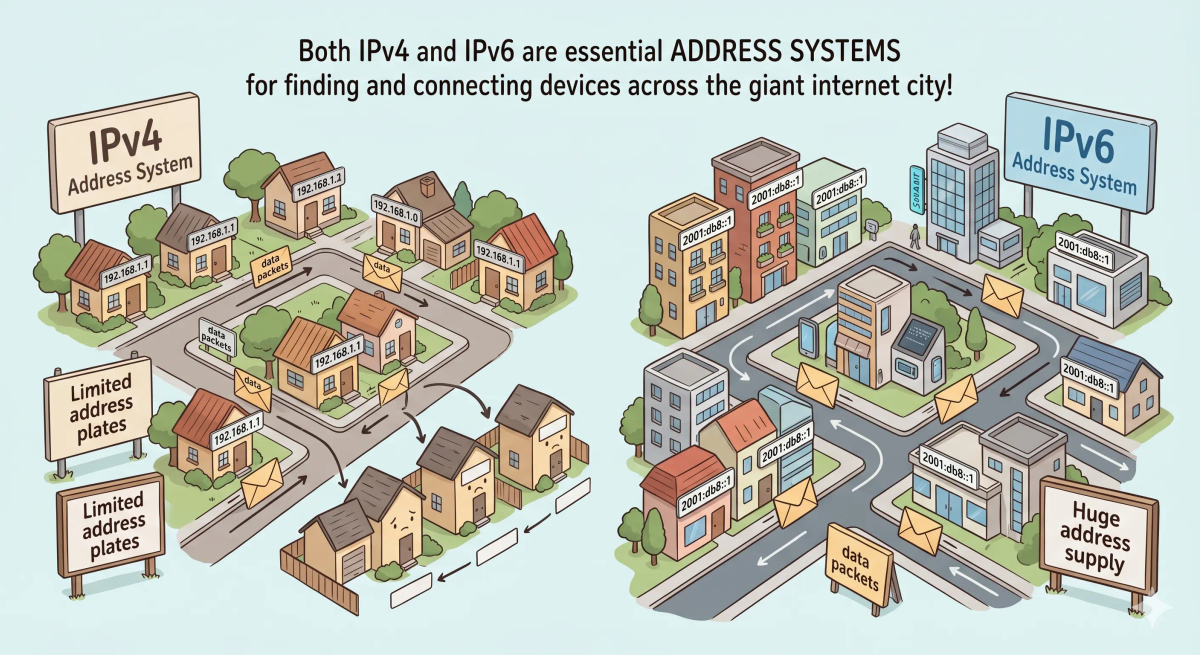
Think of IPv4 and IPv6 like two city address systems
- The internet = a giant connected city
- Devices and servers = buildings, homes, shops, and offices
- IP address = the address plate that helps data find the right place
- IPv4 = the older address system with shorter address plates
- IPv6 = the newer address system with longer address plates and far more possible addresses
- Data packets = delivery envelopes that need correct addresses
So the easiest way to understand this comparison is:
- IPv4 = the older city address format
- IPv6 = the newer expanded city address format
What Problem Does Each One Solve?
IPv4
In the city story, IPv4 solves the basic “how do we give each place an address?” problem.
It gives buildings short address plates that delivery envelopes can follow.
In the real world, IPv4 gives devices and servers numeric addresses so data can be sent to the right destination across networks.
IPv6
In the city story, IPv6 solves the “what happens when the city becomes too big for the old address system?” problem.
Instead of trying to squeeze endless new buildings into a small address list, the city creates a much larger address format.
In the real world, IPv6 provides a far bigger address space, making it possible to give unique addresses to vastly more devices and networks.
The actual difference
In the story world, IPv4 is the older city address system with fewer possible address plates, while IPv6 is the expanded address system built for a much larger city.
In the real world, that means IPv4 uses 32-bit addresses, while IPv6 uses 128-bit addresses.
So the actual difference is that IPv4 is shorter and more limited, whereas IPv6 is longer and designed for far more unique addresses.
How the Difference Works in the Story
IPv4 in the story
- A building needs an address plate.
- The city gives it a short address from the old address system.
- Delivery envelopes use that address to find the building.
- As the city grows, the old system becomes crowded.
- The city has to use workarounds to keep deliveries moving.
IPv6 in the story
- The city creates a new expanded address system.
- Each building can receive a longer, more flexible address plate.
- New neighborhoods and devices can be added without quickly exhausting the address supply.
- Delivery envelopes can still use addresses to find the right destination.
- The city is better prepared for future growth.
How the Difference Works in the Real World
IPv4 in the real world
- IPv4 addresses identify devices on a network.
- An IPv4 address is made of 32 bits.
- It is commonly written as four decimal numbers separated by dots.
- Because the address space is limited, techniques like private IP ranges and NAT are commonly used.
- IPv4 remains widely used across the internet.
IPv6 in the real world
- IPv6 addresses also identify devices on a network.
- An IPv6 address is made of 128 bits.
- It is commonly written as groups of hexadecimal characters separated by colons.
- Its address space is vastly larger than IPv4.
- IPv6 is designed to support the continued growth of the internet and connected devices.
👉 That means IPv4 and IPv6 do the same basic job, but IPv6 has a much larger address design.
Real-World Example
Example: Your laptop opening a website
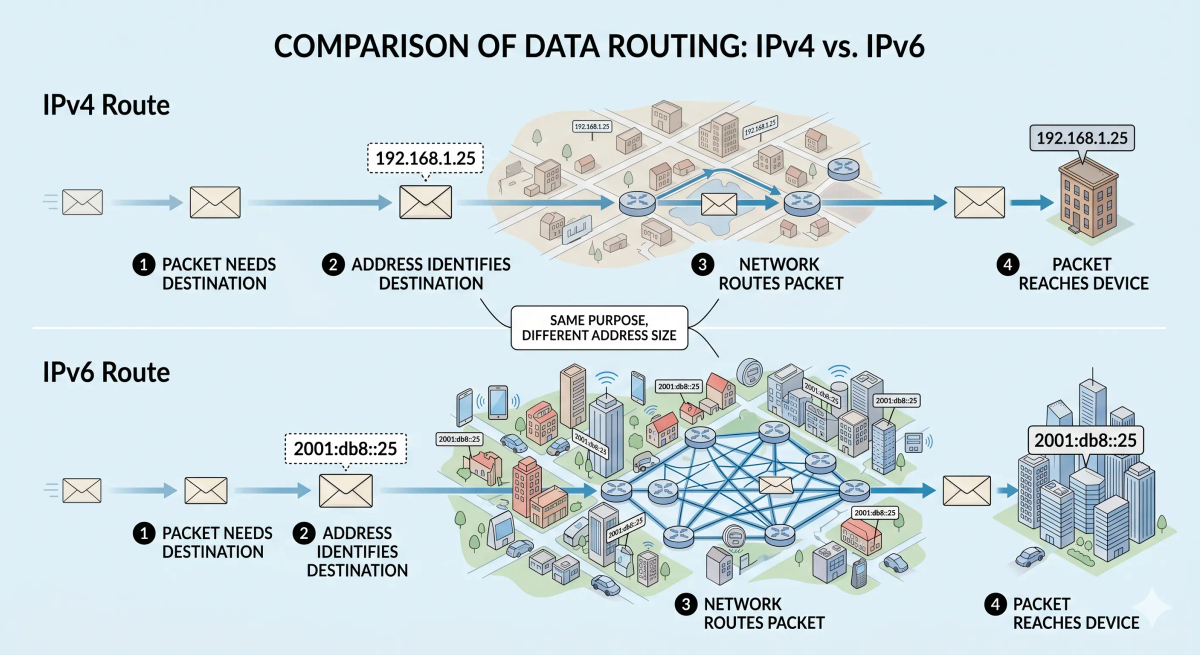
When your laptop opens a website, data has to travel between your device and a server.
To do that, devices need addresses.
If the connection uses IPv4, the address might look like 142.250.192.14.
If the connection uses IPv6, the address might look like 2607:f8b0:4005:805::200e.
In both cases, the address helps data reach the right place. The difference is the address system being used.
That is why the difference matters in practice.
The Difference Mapped Clearly
IPv4
- Older internet address version
- Uses 32-bit addresses
- Written in dotted decimal format
- Has a much smaller address space
- Still widely used today
IPv6
- Newer internet address version
- Uses 128-bit addresses
- Written in colon-separated hexadecimal format
- Has a vastly larger address space
- Designed for the long-term growth of the internet
Mental shortcut: IPv4 = old smaller address book, IPv6 = new massive address book.
What IPv4 and IPv6 Are Not
This comparison is not the same as…
- IP address — an IP address is the actual address; IPv4 and IPv6 are two versions of the address system.
- DNS — DNS helps translate names like
example.cominto IP addresses. - MAC address — a MAC address identifies network hardware on a local network, not the same thing as an internet IP address.
- URL — a URL is a full web address used by browsers, not the same as an IP protocol version.
So while these ideas are related, the unique job of this comparison is understanding two different versions of the internet addressing system.
Why the Difference Matters
- It explains why two different IP address formats exist.
- It helps you understand networking tutorials, router settings, and cloud dashboards.
- It shows why the internet needed a newer addressing system.
- It prepares you for modern networks where IPv4 and IPv6 can exist together.
This matters because IPv4 and IPv6 often appear in network settings, logs, DNS records, hosting platforms, and cloud systems.
A memorable closer: the next time you see IPv4 or IPv6, remember the city: IPv4 is the older smaller address system; IPv6 is the newer expanded address system.
A Slightly Deeper Version
A slightly deeper way to think about this comparison is that IPv4 and IPv6 are two versions of the Internet Protocol used for addressing and routing traffic between devices.
IPv4 uses a 32-bit address space, while IPv6 uses a 128-bit address space. That larger size is the main reason IPv6 can support an enormous number of unique addresses.
They may seem similar because both are IP address systems, but the real distinction is that IPv6 was created to overcome the limitations of IPv4 address capacity and support a larger internet.
Common Questions
Is IPv4 the same as IPv6?
No. They both help identify devices on networks, but they use different address formats and sizes.
Which is better: IPv4 or IPv6?
IPv6 is newer and has a much larger address space, but IPv4 is still widely used. In practice, many systems support both.
Do I need IPv4 or IPv6?
Most users do not need to choose manually. Your device, router, ISP, and websites usually handle the version used for a connection.
Why was IPv6 created?
IPv6 was created mainly because IPv4 has a limited number of possible unique addresses, and the internet kept growing.
Can IPv4 and IPv6 work together?
Yes. Many modern networks use both IPv4 and IPv6 side by side in what is often called dual-stack networking.
Why do IPv6 addresses look so long?
IPv6 addresses are longer because they use 128 bits instead of IPv4’s 32 bits, which creates a much larger address space.
In Short
- IPv4 is like an older city address system
- IPv6 is like a newer expanded city address system
- The main difference is that IPv4 uses 32-bit addresses, while IPv6 uses 128-bit addresses
- IPv4 is shorter and still common
- IPv6 is longer and built for a much larger internet